
Australia’s Housing Reality Check: Expensive, But Not Extreme Globally
It’s tough — but the data tells a more balanced story than you think
If you ask most Australians about housing affordability, you'll likely hear the same response: "It's impossible to get ahead."
With headlines dominated by soaring property prices, rental shortages, and first-home buyers struggling to enter the market, Australia has developed a reputation as one of the most unaffordable housing markets in the world.
And to a degree, that perception is justified.
Home prices have risen dramatically over the past two decades, particularly across Sydney, Melbourne, Brisbane and other major metropolitan centres. For many households, wages simply haven't kept pace with property values, making home ownership feel increasingly out of reach.
But when we step back from domestic sentiment and compare Australia against global housing affordability benchmarks, a more nuanced picture emerges.
Australia is certainly expensive. Housing affordability is under pressure. Yet contrary to popular belief, Australia is not the most unaffordable housing market globally.
In fact, several advanced economies face even greater affordability challenges.
So where does Australia actually sit on the global housing affordability scale?
Let's look at the data.
Measuring Housing Affordability: The Global Standard
One of the most widely used international measures of housing affordability is the House Price-to-Income Ratio Index.
Simply put, this index compares the cost of a typical home against the income of a typical household. The higher the ratio, the harder it becomes for average earners to purchase property.
It answers a simple question:
How many years of income does it take to buy a home?
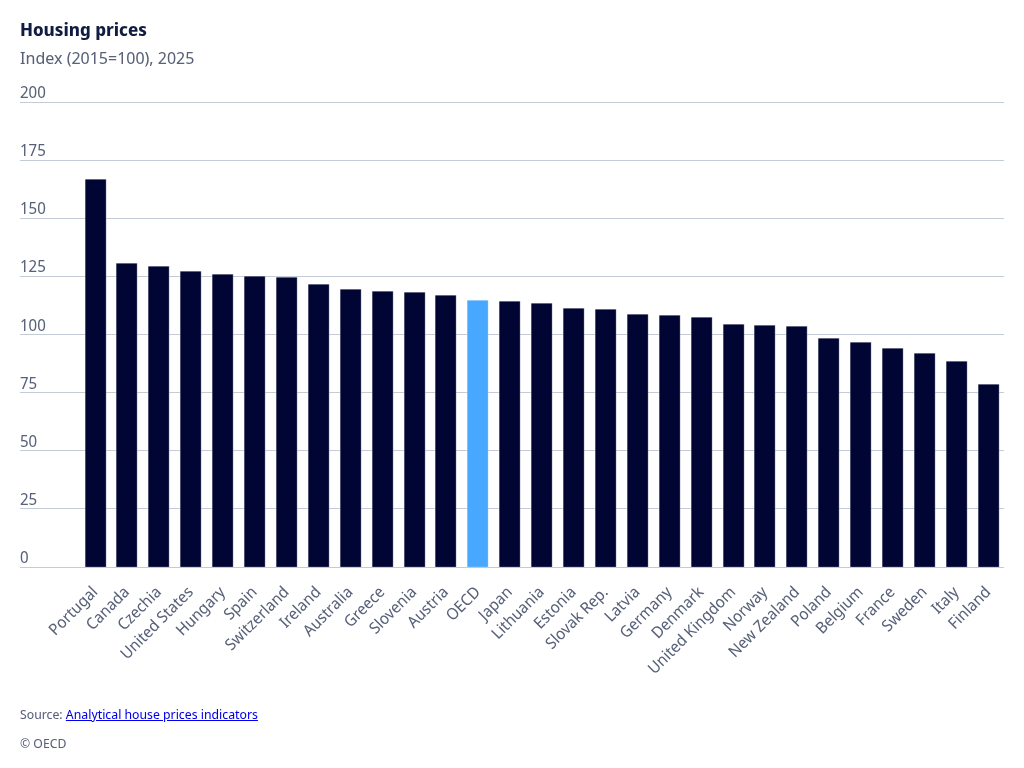
Using OECD-aligned housing affordability data for 2025, Australia ranks within the higher-cost group of developed nations—but not at the extreme end of the spectrum.
What the Data Actually Tells Us
At first glance, Australia's score of 119.5 reinforces what many households already feel every day:
Housing is expensive.
However, the international comparison reveals three important insights that are often overlooked in public debate.
1. Australia Is Above the OECD Average — But Not an Extreme Outlier
The OECD average currently sits at 114.7.
Australia's score places it above that benchmark, indicating affordability pressures are certainly present. However, the gap is not as large as many people assume.
In other words, Australia is expensive—but not uniquely so among advanced economies.
2. Several Countries Face More Severe Affordability Challenges
When compared globally, a number of countries now experience significantly higher house price-to-income burdens than Australia.
These include:
Portugal
Netherlands
Canada
In these markets, housing costs have risen even further relative to household incomes, creating greater affordability strain than that experienced by the average Australian household.
3. Australia Sits in the "High-Cost, High-Pressure" Category
The data suggests Australia is best described as:
A high-cost housing market with structural affordability challenges, but not one of the most distorted housing markets in the developed world.
That's an important distinction.
Australia faces genuine affordability issues, yet it remains part of a broader global trend affecting many advanced economies where housing supply struggles to keep pace with population growth and demand.
So Why Does Housing Feel So Unaffordable?
If Australia isn't the worst globally, why does housing feel so difficult for so many people?
The answer lies in the lived experience of Australian households.
Several local factors amplify affordability pressures.
Wage Growth Hasn't Kept Up
For decades, property values have generally risen faster than wages.
As a result, even people earning reasonable incomes often find themselves falling further behind the market rather than catching up to it.
The challenge isn't simply that homes are expensive.
It's that incomes haven't increased at the same pace.
Higher Interest Rates Increase Mortgage Stress
Borrowing costs matter.
When interest rates rise, purchasing power falls.
Even if house prices stabilise, higher mortgage repayments reduce affordability and place additional pressure on households carrying debt.
This has been particularly noticeable during the recent rate-tightening cycle.
Housing Supply Remains Constrained
Australia's housing shortage is well documented.
Factors such as:
Planning and zoning restrictions
Construction cost inflation
Labour shortages
Population growth
Infrastructure bottlenecks
have all limited the speed at which new housing can be delivered.
When demand consistently exceeds supply, affordability naturally deteriorates.
Demand Is Concentrated in a Small Number of Cities
Unlike many countries with numerous large economic centres, Australia's population and employment opportunities are heavily concentrated.
Sydney, Melbourne, Brisbane and increasingly Perth attract the majority of migration, investment and employment growth.
This concentrates housing demand into relatively small geographic areas, intensifying competition for available property.
The Critical Distinction Most Housing Debates Miss
One of the biggest misconceptions in housing discussions is the tendency to treat all affordability measures as the same thing.
They are not.
There is a significant difference between:
Absolute Housing Cost
What a property costs.
and
Relative Affordability
How that cost compares to household income.
Australia ranks highly in terms of absolute property prices, particularly in major cities.
However, when affordability is measured relative to incomes and compared internationally, Australia sits more comfortably within the middle-to-upper range of developed economies rather than at the extreme end.
Understanding this distinction helps explain why Australia can simultaneously feel unaffordable while not ranking as the worst globally.
Both statements can be true.
Looking Beyond Property Prices
Housing affordability is only one piece of the broader wealth-building puzzle.
Many Australians assume financial success is determined solely by income.
Yet history consistently shows that long-term wealth is typically created through strategy, structure and disciplined decision-making rather than income alone.
As Sally-Ann Benson, Founder and CEO of PWF Australia, explains:
“The biggest misconception in Australia today is that wealth is built through income alone. Wealth is built through strategy. Most Australians already have the ingredients they need — income, equity, superannuation and time — but they lack a plan that connects them.”
For many households, the challenge isn't necessarily earning more.
It's making better use of the resources they already have available.
Final Thought
There is no denying that Australia's housing market is under pressure.
Buying a home has become harder. Mortgage repayments have increased. Rental markets remain tight. And affordability concerns are real.
But the global data also reminds us that Australia's housing market is not uniquely broken.
It sits within a group of advanced economies grappling with many of the same structural challenges: constrained supply, population growth, urban concentration and rising demand.
Understanding where Australia truly stands helps move the conversation beyond headlines and towards practical solutions.
At PWF, we specialise in helping property investors and families make sense of their financial position and structure their finances in a way that supports long-term wealth creation — even in a high-cost housing market like Australia. If you’re feeling this pressure, PWF can help you structure your finances so you can continue growing your wealth with clarity and confidence.
Data Sources
OECD Housing Price-to-Income Index (2025 dataset)
https://www.oecd.org/en/data/indicators/housing-prices.html Statista Global Housing Affordability Dataset (2025)
https://www.statista.com/statistics/237529/price-to-income-ratio-of-housing-worldwide/ Australian Institute of Health and Welfare – International Housing Comparisons
https://www.aihw.gov.au/reports/australias-welfare/international-comparisons-of-welfare-data
DisclaimerThis content is general in nature and does not constitute financial, tax, or investment advice. Readers should consider their personal circumstances and seek advice from a qualified professional before making any financial decisions.