
Negative Equity in Australia: Why more than 99% of Homeowners Are In a Very Strong Position
Don't Believe the Doom and Gloom: More than 99% of Australian Homeowners Are Doing Well
Recent headlines have focused on falling property prices in Sydney and Melbourne, with some commentators warning that first-home buyers and recent purchasers could find themselves in negative equity.
It's an attention-grabbing term, but the reality is far less alarming than many headlines suggest.
According to Reserve Bank data, fewer than 1% of Australian homeowners are currently in negative equity. That means more than 99% of borrowers still have enough equity in their property to cover their outstanding mortgage, even if they needed to sell.
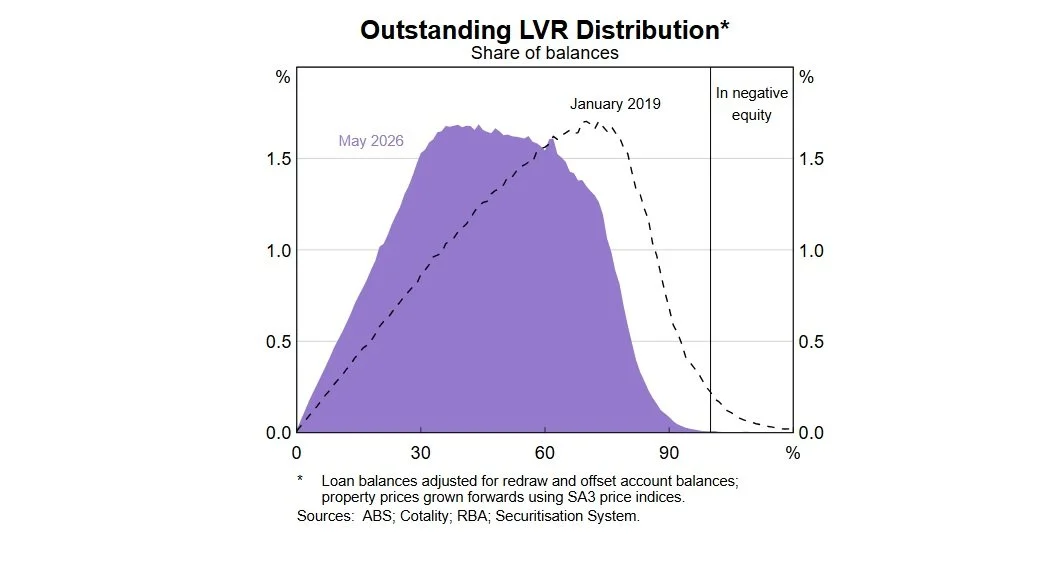
At Property Wealth Finance (PWF), we believe it's important to look beyond short-term market movements and focus on what truly drives long-term wealth creation.
What Is Negative Equity?
Negative equity occurs when the value of a property falls below the amount owed on the mortgage.
For example:
Property purchased for $700,000
Loan balance of $665,000 (95% LVR)
Property value falls to $640,000
In this scenario, the owner owes more than the property's current market value.
While this can make refinancing more difficult, it does not automatically create financial stress or mean someone has made a poor investment decision.
Why Negative Equity Is Often Overstated
One of the biggest misconceptions about negative equity is that it immediately creates a financial crisis.
In reality, if you:
Continue making your mortgage repayments
Have stable employment and income
Do not need to sell
Then a temporary decline in value may have little practical impact on your day-to-day financial position.
Property values move in cycles. Markets rise, pause, correct, and then grow again.
Australian property history shows that short-term fluctuations are normal, while long-term trends have generally remained positive in well-selected locations.
The Media Focuses on Price Falls. Investors Focus on Time.

Many recent reports have highlighted price declines in Sydney and Melbourne.
However, what often gets overlooked is where those declines are occurring.
The largest corrections have generally been concentrated in premium and higher-priced suburbs. Meanwhile, many affordable growth corridors and first-home buyer markets have remained resilient or continued growing.
For example, several outer suburban markets across Melbourne, Brisbane, Adelaide, Perth, and regional centres have continued to experience strong population growth, infrastructure investment, and housing demand.
This reinforces an important principle:
Not all property markets move together.
Australia does not have one property market. It has thousands of local markets, each influenced by different economic and demographic factors.
Why Strategic Property Selection Matters
At PWF, we often remind clients that buying property is not simply about entering the market.
It's about entering the right market.
Many investors who purchase based solely on affordability, emotion, or media hype can find themselves owning assets with limited growth potential.
On the other hand, investors who focus on:
Population growth
Employment opportunities
Infrastructure investment
Housing supply constraints
Long-term demand drivers
are generally better positioned to weather short-term market fluctuations.
This is why research and strategy matter far more than trying to predict what property prices will do over the next six months.
When Negative Equity Becomes a Real Problem
Negative equity becomes more significant when combined with a life event that forces a sale.
Examples include:
Job loss
Relationship breakdown
Serious illness or injury
Financial hardship
Unexpected relocation
In these situations, owners may not have the luxury of waiting for the market to recover before selling.
However, even then, Australian banks typically work with borrowers to find solutions before pursuing a forced sale.
The key message is simple:
If you're experiencing financial difficulty, speak with your lender early.
Most lenders would prefer to help borrowers remain in their homes rather than force a sale.
The Refinancing Challenge
One practical consequence of negative equity is that refinancing can become more difficult.
Lenders generally prefer borrowers to have sufficient equity before approving a refinance application.
This can temporarily limit access to:
Better interest rates
Equity release opportunities
Alternative lending options
However, this situation often improves naturally over time through:
Regular loan repayments
Property value growth
Additional savings contributions
For many borrowers, negative equity is a temporary phase rather than a permanent problem.
What Investors Should Really Be Watching
Rather than focusing on short-term price movements, investors should pay attention to the factors that drive long-term growth:
Population Growth
Areas attracting new residents typically experience stronger housing demand.
Employment Opportunities
Regions with diverse and growing employment markets tend to support sustainable property growth.
Infrastructure Investment
Major transport, health, education, and commercial projects often stimulate economic activity and housing demand.
Housing Supply
Markets with limited supply and growing demand generally outperform over time.
Holding Power
The ability to comfortably hold an investment through market cycles is often more important than short-term price fluctuations.
The PWF Perspective
The biggest risk in property investing is rarely a temporary decline in value.
The bigger risk is purchasing the wrong property, in the wrong location, with no clear strategy.
Property investing should never be viewed as a 12-month game.
The investors who consistently build wealth are those who understand market cycles, focus on quality assets, and maintain a long-term perspective.
Negative equity may sound alarming, but the data tells a different story. With fewer than 1% of Australian homeowners affected, it remains a relatively uncommon issue.
For most Australians, the focus should not be on short-term market headlines.
It should be on building a sustainable property portfolio, managing debt responsibly, and owning assets that are positioned for long-term growth.
Because wealth is rarely built by reacting to the latest headline.
It's built through strategy, patience, and disciplined decision-making over time.
Sources and Market Data
The insights discussed in this article are supported by data and commentary from leading Australian property and economic institutions:
The Reserve Bank of Australia (RBA) reported that less than 1% of Australian households are currently in negative equity, highlighting the strong equity positions held by most borrowers despite recent market softness.
Recent Domain research found that Sydney and Melbourne house prices declined by more than 3% during the June 2026 quarter, reflecting a normal cyclical correction rather than a market crash. Domain's economists noted that the market is experiencing a typical downturn phase following an extended growth cycle.
Housing Australia data shows that fewer than 1% of participants in the Federal Government's First Home Guarantee Scheme have experienced negative equity, despite many purchasing with deposits as low as 5%.
The RBA's Financial Stability Review also noted that Australian borrowers continue to hold substantial equity and liquidity buffers, reducing the likelihood of widespread mortgage stress or forced sales.
References
This article is general information only and does not constitute financial, tax, legal, or investment advice. Property markets are cyclical and individual circumstances vary. Investors should seek professional advice before making investment decisions.