
If you follow the daily news, you could be forgiven for thinking that now is one of the worst times to buy land or property in Melbourne.
Interest rates remain elevated, borrowing costs are putting pressure on household budgets, property transactions have slowed, and economic uncertainty continues to dominate the headlines. Many prospective buyers are choosing to sit on the sidelines, waiting for interest rates to fall and the market to show clearer signs of recovery.
But what if the opportunity is not waiting for the market to recover?
What if the conditions that are making other buyers hesitate are precisely what could create an opportunity for those prepared to look beyond the headlines?
For smart buyers and long-term investors, this hesitation is the biggest opportunity in years!
Melbourne's property market deserves a closer look.
Behind the headlines, several important market dynamics are developing. Relative affordability, developer incentives, changing land supply and Victoria's population growth are creating a market environment worth investigating.
For buyers who have the financial capacity, a clear investment strategy and a long-term outlook, this could be an interesting time to explore opportunities in Melbourne's land and property market.
Let's look at why.
1. Melbourne Is Offering a Relative Affordability Advantage
For decades, Melbourne was firmly established as Australia's second-most-expensive capital city property market.
However, the market has undergone a significant adjustment.
With Melbourne's median house price sitting at approximately $943,000 in the figures cited for this market analysis, the city is now comparatively more affordable than several other major Australian capitals, including Brisbane, Adelaide and Perth.
This represents an important change in the relative value proposition of Australia's property markets.
Consider what this means for buyers.
In cities where property prices have experienced stronger growth, affordability has become an increasingly significant barrier. Higher purchase prices mean buyers generally need larger deposits, greater borrowing capacity and more income to enter the market.
Melbourne, by comparison, offers buyers a different starting point.
Its relative affordability may provide an opportunity to access established suburbs, emerging growth corridors and land opportunities at a lower entry price than comparable markets elsewhere.
There is another important consideration: rental demand.
Melbourne's rental market has demonstrated resilience, with gross rental yields presenting an attractive consideration for investors assessing the relationship between purchase price and rental income.
However, rental yield alone should never determine an investment decision. Investors also need to consider vacancy rates, ongoing ownership costs, financing expenses, potential maintenance and the property's long-term prospects.
The opportunity is not simply that Melbourne is cheaper. It is that buyers may be able to secure an asset at a more favourable entry point while positioning themselves for potential future market growth.
For investors who have been priced out of other capital cities, Melbourne deserves a place on the shortlist.
2. What Australia's Latest Property Market Indicators Are Telling Us
One of the most important considerations when assessing a property investment is understanding that Australia is not one single property market.
Conditions can vary considerably between capital cities, and even between suburbs within the same city.
Herron Todd White’s October 2026 Capital City Property Market Indicators provide an interesting comparison of housing market conditions across Australia's eight capital cities.
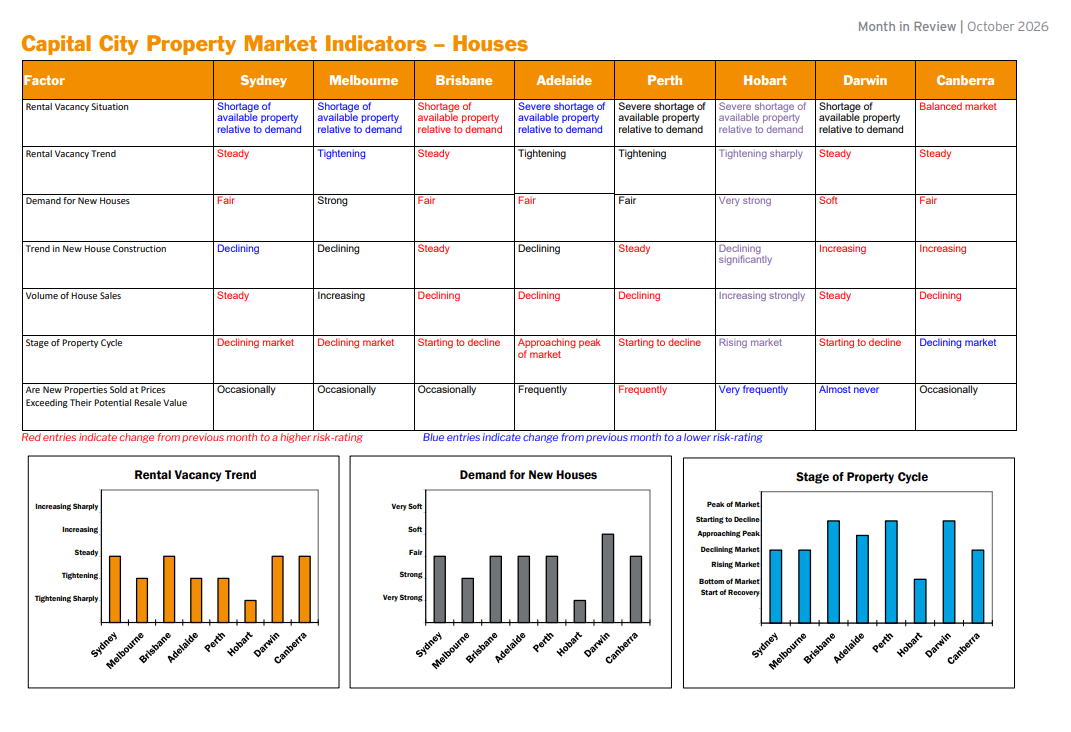
Source: October 2026 Australian Property Month in Review
The indicators assess several important factors, including rental vacancy conditions, rental vacancy trends, demand for new houses, construction activity, house sales volumes, property market cycles and whether new properties are selling at prices exceeding their potential resale value.
So, what stands out for Melbourne?
Rental vacancy remains tight.
The October indicators identify a shortage of available rental properties relative to demand in Melbourne. The rental vacancy trend is also tightening.
This is an important consideration because rental availability and tenant demand can influence the attractiveness of an investment property.
Demand for new houses remains strong.
Melbourne is one of the few capital cities in the comparison showing strong demand for new houses, rather than fair or soft demand.
This suggests that underlying demand remains an important part of the city's housing market fundamentals.
New house construction is declining.
The indicators also show declining new house construction in Melbourne.
When housing construction slows while population and housing demand continue to create accommodation requirements, the relationship between future supply and demand becomes particularly important.
House sales volumes are increasing.
Despite the broader market uncertainty, Melbourne's house sales volumes are increasing according to the October indicators.
This is another factor worth monitoring as buyer activity evolves.
Melbourne remains in a declining market phase.
Perhaps the most interesting observation is that Melbourne is still classified as being in a declining market phase.
This creates a contrast between its underlying housing demand indicators and its current property market cycle.
For investors, this is precisely why looking at multiple indicators matters.
A market can experience softer prices or declining market conditions while still having strong rental demand, limited housing availability and positive long-term fundamentals.
The objective is not to assume that every property will perform well. It is to identify locations and assets where the underlying fundamentals support a sensible long-term investment decision.
“Some of the best property opportunities can emerge when the market is quieter and other buyers are sitting on the side lines.
In Melbourne, we’re seeing an interesting combination of relative affordability, strong demand for new homes and tightening rental availability.
For buyers with the right financial position and a long-term strategy, this is a market worth paying attention to. It’s not about trying to time the bottom – it’s about recognising value, doing your research and making informed decisions.”
3. A Housing Supply Challenge Could Be Developing Behind the Scenes
One of the most important factors influencing property markets over the long term is the relationship between population growth and housing supply.
People need somewhere to live. When the number of people requiring housing increases faster than the number of homes being delivered, pressure can build across both rental and purchase markets.
Victoria continues to experience significant population growth, supported by overseas migration, interstate movement and natural population increases.
The figures cited in this analysis indicate that Victoria is adding approximately 86,000 net migrants annually, contributing to population growth of around 1.6%.
Every additional household needs accommodation.
That demand flows into established housing, apartments, townhouses, rental properties and newly developed residential communities.
However, building enough new homes to accommodate population growth is not straightforward.
Land availability, planning approvals, construction costs, infrastructure delivery, developer financing and buyer confidence all influence how quickly new housing can reach the market.
When market conditions become challenging, developers may respond by slowing land releases, postponing projects or reducing the number of new developments they bring to market.
This creates an interesting dynamic.
While population growth continues to support underlying housing demand, the delivery of new housing can slow down.

Why does this matter for land buyers?
Land is a finite resource, particularly in locations where infrastructure, planning approvals and residential development opportunities are becoming increasingly constrained.
If fewer new lots are being released today, the consequences may become more visible in the future when buyer demand improves.
The figures cited for this analysis suggest that new lot releases have declined by approximately 18% quarter-on-quarter in some Victorian markets, with particularly significant reductions reported in areas such as Geelong.
While these figures need to be assessed against individual development pipelines and local market conditions, they highlight an important consideration for investors.
Today's slowdown in new land supply could influence tomorrow's availability of residential land.
When buyer confidence eventually improves, developers cannot necessarily increase supply overnight. New estates require planning, infrastructure, construction and significant capital investment.
This means the relationship between today's supply decisions and tomorrow's housing availability is worth watching closely.
For long-term investors, understanding where future demand may emerge and whether sufficient housing supply will be available is an important part of identifying potential opportunities.
4. Developers Are Offering Incentives That May Not Be Available in a Stronger Market
One of the most interesting features of a slower property market is how it changes the negotiating position of buyers.
When demand is strong, developers can often sell land quickly, sometimes with multiple buyers competing for the same release.
When buyer activity slows, the dynamics change.
Developers still have commercial obligations. They may have completed land, infrastructure costs, financing commitments and project delivery targets.
They also need to maintain sales momentum to support the financial viability of their developments.
This can create opportunities for buyers who are ready to act.
Rather than significantly reducing advertised prices, some developers may offer incentives such as:
Cash rebates or purchase incentives.
Reduced deposits or more flexible deposit arrangements.
Contributions towards selected purchasing costs.
Upgrades or additional inclusions.
Incentives on selected titled or completed lots.
Negotiated terms on available stock.
For buyers, this creates an important distinction between the advertised price and the effective purchase price.
A block of land advertised at a particular price may come with incentives that materially change the overall financial equation.
For example, consider a hypothetical titled land purchase:
ItemExampleAdvertised land price$400,000Developer incentive$20,000Effective price before other costs$380,000
The example illustrates why buyers should evaluate the complete offer rather than simply comparing advertised prices.
Of course, incentives vary between developments, individual lots and contract conditions. Buyers should also understand whether an incentive is paid upfront, applied at settlement or subject to specific conditions.
Why titled land deserves particular attention
Titled land is land that has completed the relevant subdivision and registration processes and is generally ready for the next stage of development, subject to applicable requirements.
For buyers who want to build, this can reduce some of the uncertainty associated with waiting for a subdivision to be completed.
It may also provide access to opportunities where developers are motivated to sell completed stock.
In parts of Melbourne's western growth corridor, the figures cited in this analysis suggest that some completed land is taking more than eight months to sell.
This highlights the importance of assessing individual estates and negotiating opportunities rather than assuming every development is experiencing the same market conditions.
The advantage for buyers is not necessarily finding the cheapest block. It is finding the right block, in the right location, at the right price and with favourable purchasing conditions.
5. Melbourne's Growth Corridors Could Offer Long-Term Opportunities
Melbourne is not one single property market.
Different suburbs, growth corridors and residential communities have different economic drivers, infrastructure requirements, employment opportunities and levels of housing supply.
This is particularly important when assessing land investment opportunities.
Melbourne's western, northern and southeastern growth corridors are continuing to evolve as residential communities.
Population growth, employment expansion, transport infrastructure, education facilities, healthcare services and retail developments all influence the attractiveness of these locations.
For investors, the question should not simply be whether Melbourne property prices will increase.
A more useful question is:
Which locations are positioned to benefit from population growth, employment opportunities and future infrastructure investment?
When assessing a potential land purchase, investors should consider:
Population growth: Is the surrounding area attracting new residents and households?
Employment opportunities: Are there established or emerging employment centres nearby?
Infrastructure: What transport, road, education and healthcare projects are planned or under construction?
Housing demand: Is there a demonstrated need for additional residential accommodation?
Land supply: How much competing land is available in the surrounding area?
Rental demand: What is the local rental market doing, and what type of housing is required?
Resale potential: Would the property appeal to future owner-occupiers and investors?
It is also important to distinguish between announced infrastructure and completed infrastructure. A proposed project does not automatically translate into increased property values.
The strongest investment decisions are based on current evidence, realistic assumptions and careful location-specific research.
A well-located property with access to employment, transport and essential services may have a stronger long-term appeal than a cheaper property in an area where future demand is less certain.
6. Why Waiting for Interest Rate Cuts Could Mean Facing More Competition
One of the most common responses to the current market is:
"I'll wait until interest rates come down before buying."
It is understandable.
Higher interest rates affect borrowing capacity, monthly repayments and household cash flow. Buyers naturally want to feel more financially comfortable before committing to a major purchase.
However, there is another side to this decision.
When interest rates eventually stabilise or begin to fall, buyer confidence may improve.
People who have postponed purchasing decisions may return to the market. Investors who have been waiting for better conditions may start looking again. First-home buyers may feel more confident about their borrowing capacity.
As demand improves, competition for desirable properties and land could increase.
This can influence:
The availability of selected land releases.
The incentives developers are prepared to offer.
The negotiating power of buyers.
The number of competing purchasers.
The prices sellers are willing to accept.
It is important to recognise that this outcome is not guaranteed. Interest rate reductions do not automatically result in immediate property price growth, and different locations can respond differently.
However, the principle of counter-cyclical buying remains relevant.
When everyone wants to buy, competition can make it harder to secure value. When fewer buyers are active, there may be more room to negotiate.
This is why waiting for the market to feel completely comfortable is not always the best approach.
The objective should not be to predict the exact bottom of the market.
It should be to identify an opportunity that makes financial sense based on today's conditions, your borrowing capacity and your long-term investment objectives.
7. The Best Time to Buy Is Not Necessarily When the Headlines Are Positive
Property investment is a long-term financial decision.
Yet many people make purchasing decisions based on short-term market sentiment.
When prices are rising, confidence increases and more buyers enter the market.
When prices fall or economic uncertainty increases, people become cautious and delay their decisions.
This creates a familiar cycle.
The difficulty is that by the time the media is reporting a strong recovery and confidence has returned, some of the most attractive purchasing opportunities may already have passed.
Experienced investors understand that market cycles are part of property investing.
There will be periods of growth, periods of adjustment and periods when markets move sideways.
Not every suburb performs equally, and not every property delivers the same results.
However, investors who understand the fundamentals can use changing market conditions to reassess opportunities.
A softer market may provide:
More time to research and compare properties.
Greater negotiating power with developers and sellers.
Access to incentives that may be harder to secure in stronger conditions.
Less competition for selected opportunities.
The ability to make considered decisions rather than rushed purchases.
The important distinction is between buying simply because something is discounted and buying because the underlying investment makes sense.
A discount does not automatically make a property a good investment.
Location, land characteristics, purchase price, rental demand, ongoing costs, financing and long-term suitability all matter.
This is where having a strategy becomes particularly important.
8. Why Your Investment Strategy Matters More Than Ever
The current market environment reinforces an important principle: property investing should never start with simply finding a property to buy.
It should start with understanding what you want to achieve financially.
Are you looking to build long-term capital growth?
Do you want to generate additional rental income?
Are you trying to create a property portfolio that could support your retirement?
Would you like to use available equity to explore future investment opportunities?
Or are you looking to diversify your wealth beyond your family home?
These are very different objectives, and they may require different property selections, financial structures and investment strategies.
For example, a buyer focused on rental income may prioritise a different property profile from someone primarily seeking long-term capital growth.
Similarly, someone planning to hold an investment for 15 or 20 years may assess the opportunity differently from someone with a shorter investment horizon.
Your income, existing debts, available equity, borrowing capacity, household expenses and future financial commitments also need to be considered.
A property that looks attractive on paper may not be appropriate for your personal financial circumstances.
That is why a strategic approach matters.
At PWF, we believe property investment should be about more than purchasing an asset. It should be about understanding how that asset fits into your broader financial future.
The right strategy considers where you are today, what you want to achieve and how property could potentially contribute to your long-term wealth objectives.
Ready to Explore Melbourne Property Opportunities?
At PWF, we believe successful property investing starts with a strategy, not simply a property purchase.
Our team helps Australians assess their financial position, understand their borrowing capacity and explore property opportunities aligned with their individual wealth creation objectives.
If you are considering investing in Melbourne, now could be a good time to understand what opportunities are available and whether they are right for you.
Through our network and property research process, we can help you explore selected land and property opportunities, assess potential locations and understand how an investment could fit into your broader financial plan.
Don't make your next property decision based on the headlines. Make it based on a strategy.
Speak with the PWF team today to explore your property investment options and take the first step towards a more informed financial future.