
Look beyond short-term dips. Think long-term growth and your retirement future.
If you have 20 years until retirement, the next two decades could be some of the most important years in your financial life. The question isn't simply where property prices are today. It's whether you have a strategy to make the most of the time you have left.
Property prices are falling. Interest rates are changing. Economic uncertainty is making headlines.
For many Australians, these are reasons to put their investment plans on hold.
But what if we looked beyond today's headlines and examined what has happened to Australian property prices over the past 30 years?
The numbers tell an interesting story. And for anyone hoping to retire comfortably in the next 20 years, there's an important lesson worth understanding.
What Has Happened to Australian Property Prices Since 1996?
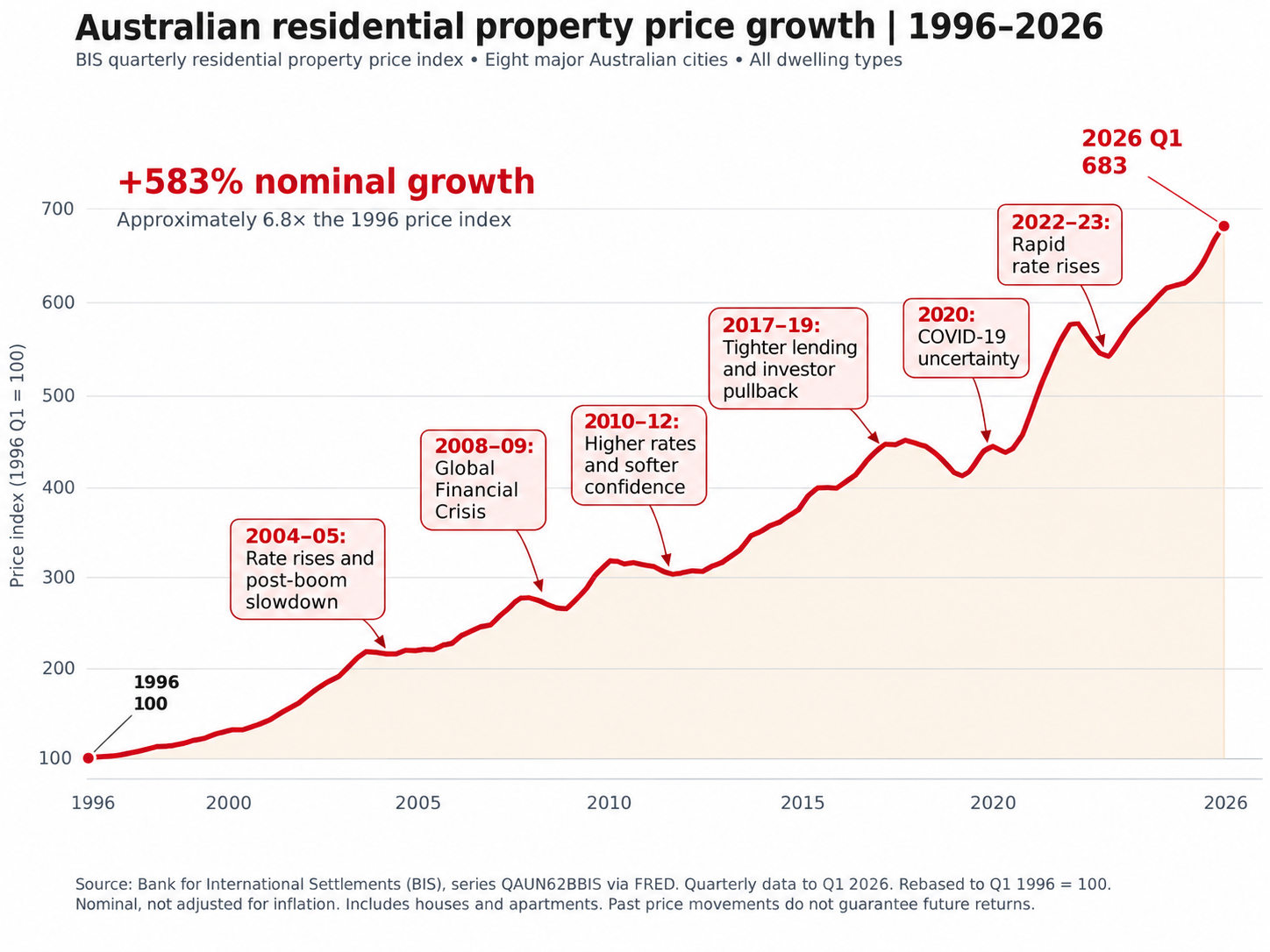
How to Read This Chart: The chart above shows how Australian residential property prices have changed since 1996, using a price index rather than actual property values.
We start at 100 in 1996. By 2026, the index had risen to approximately 683, representing a 583% increase over 30 years.
According to the Bank for International Settlements (BIS), Australian residential property prices increased approximately 583% between the first quarter of 1996 and the first quarter of 2026.
That's almost seven times their original value.
Here's what the figures show:
| Measure | 1996 | 2026 |
|---|---|---|
| Australian residential property price index | 31.66 | 216.13 |
| Price relative to 1996 | 1× | 6.83× |
| Total nominal price growth | — | +583% |
Source: Bank for International Settlements (BIS), Residential Property Prices for Australia, via FRED. Q1 1996 to Q1 2026. Nominal price index, not adjusted for inflation. Past performance does not guarantee future results.
What Does 583% Growth Actually Mean?
Let's put it into everyday Australian terms.
Imagine a property worth $200,000 in 1996.
If that property's value had increased at exactly the same rate as the BIS index, it would be worth approximately $1.37 million in 2026.
| Property Value Example | Amount |
|---|---|
| Starting value in 1996 | $200,000 |
| Illustrative value in 2026 | $1,365,600 |
| Increase in property value | +$1,165,600 |
Source: Illustrative calculation based on the Bank for International Settlements (BIS) Residential Property Price Index for Australia, Q1 1996 to Q1 2026. Assumes the property grows in line with the index. Excludes inflation, interest, taxes, maintenance and other ownership costs. Individual property performance varies. Past performance does not guarantee future results.
That's more than $1.16 million in additional property value over 30 years.
Of course, this is an illustration based on the overall index, not the actual performance of a particular property. Individual properties, suburbs and cities have experienced very different results. The example also excludes interest, taxes, maintenance and other ownership costs.
Nevertheless, it demonstrates something important:
Property wealth has often been built over decades, not months.
But Property Prices Didn't Rise Every Year
This is where the history becomes particularly interesting.
Between 1996 and 2026, Australia experienced:
The late-1990s economic and property market changes.
The Global Financial Crisis of 2008.
Periods of rising interest rates and slowing house-price growth.
Property market corrections in 2018–2019.
The COVID-19 pandemic and its economic uncertainty.
A sharp rise in interest rates from 2022.
Further changing economic and property market conditions in 2026.
Throughout these events, there were times when buying property felt risky.
Some buyers waited for more certainty. Others reduced their investment activity, and some investors who had sufficient financial capacity continued to look for opportunities.
Yet despite the downturns, the overall nominal price index increased substantially over the 30-year period.
That's not to say every downturn was a buying opportunity, or that every property eventually delivered strong returns.
It means something more useful:
Short-term market movements and long-term investment outcomes are not the same thing.
Why Market Downturns Can Create Opportunities
Think about what typically happens when property markets are strong.
Buyer confidence increases. More people start attending open homes. Competition for desirable properties can intensify.
In some locations, buyers may find themselves paying more or making decisions quickly to secure a property.
Now consider the opposite environment.
When confidence weakens, some buyers step away from the market. Properties may take longer to sell. Vendors can become more willing to negotiate.
For financially prepared buyers, that can create opportunities to:
Research markets with less urgency.
Negotiate on price and contract conditions.
Compare more properties before making a decision.
Focus on rental demand, cash flow and long-term fundamentals.
Purchase with a clear strategy rather than reacting to market excitement.
Importantly, lower competition doesn't automatically mean a property is good value.
Some markets may continue to decline. Interest rates can remain elevated. Rental costs, holding costs and borrowing capacity all matter.
The opportunity is not simply buying because prices have fallen.
The opportunity is being prepared to recognise genuine value when others may be hesitant.
If You Have 20 Years Until Retirement, Here's What History Should Make You Think About
Let's imagine you're 45 years old today and planning to retire at 65.
You have 20 years.
That might sound like plenty of time, but those years can pass quickly between raising a family, paying down a mortgage, managing household expenses and planning for the future.
The bigger question is:
When your regular employment income stops, what assets or income sources will help support the lifestyle you want?
Many Australians expect their superannuation and the Age Pension to play important roles.
But have you calculated what your actual retirement lifestyle might cost?
What Does a Comfortable Retirement Cost Today?
The Association of Superannuation Funds of Australia (ASFA) estimates that, as of June 2026, the annual budget required for a comfortable retirement is approximately:
| Retirement Household | Annual Spending |
|---|---|
| Single homeowner | $56,166 |
| Couple who own their home | $78,998 |
Source: Association of Superannuation Funds of Australia (ASFA), Retirement Standard, June quarter 2026. Figures represent estimated annual expenditure for a comfortable retirement for homeowners and may differ depending on individual circumstances.
These benchmarks assume particular living arrangements and spending patterns, including home ownership. Your own needs could be higher or lower.
Now consider inflation.
If a couple's $78,998 annual retirement budget increased by an average of 3% per year for the next 20 years, the equivalent spending would be approximately $142,700 a year by 2046.
That's not a forecast. It's a simple illustration of how inflation can affect future living costs.
And it highlights the challenge.
Having enough money for retirement isn't just about today's cost of living. It's about what your money will need to pay for in the future.
What Could the Next 10 or 20 Years Mean for Property?
Let's return to the property data.
Between 1996 and 2026, the BIS index increased approximately 583%, equivalent to a compound annual growth rate of around 6.6%.
If Australian property prices continue growing at the same average annual rate as 1996–2026, the residential property price index could reach approximately 410 by 2036.
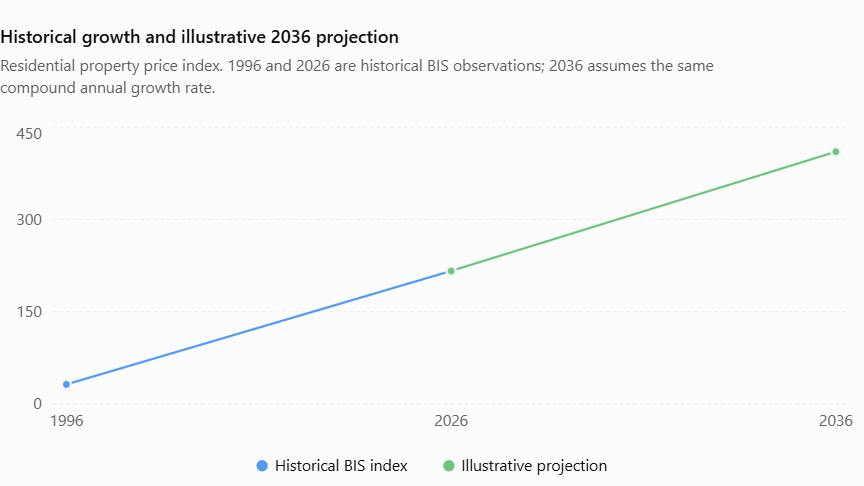
That's a hypothetical projection based on historical growth of approximately 6.6% per year, not a forecast.
| Measure | 1996 | 2026 | 2036 (Projection) |
|---|---|---|---|
| Property price index | 31.66 | 216.13 | 410.00 |
| Relative to 1996 | 1× | 6.83× | 12.95× |
| Growth since 2026 | — | — | +89.7% |
Source: Bank for International Settlements (BIS), Residential Property Price Index for Australia, via FRED, Q1 1996 to Q1 2026. The 2036 figures are hypothetical projections assuming the historical compound annual growth rate of approximately 6.6% continues for another 10 years. These are not forecasts or guaranteed returns. Index values are nominal and do not account for inflation. Actual property market performance may differ significantly.
That is a historical average, not a prediction (but a mathematical projection) of what will happen next.
What does that mean for everyday Australians?
If a property is worth $600,000 today, and it grows at the same historical average rate:
Illustrative property value in 2036
$1,138,202
Potential increase of $538,202 over 10 years
To understand how different growth outcomes could affect a property over 20 years, consider a hypothetical property worth $600,000 today.
| Illustrative Annual Growth | Property Value After 20 Years |
|---|---|
| 2% per year | $891,568 |
| 4% per year | $1,314,674 |
| 6% per year | $1,924,281 |
Note: Illustrative projections based on a starting property value of $600,000 and annual compound growth over 20 years. These scenarios are mathematical examples only, not forecasts or guaranteed returns. Figures exclude inflation, borrowing costs, taxes, transaction costs, maintenance and other ownership expenses. Actual investment outcomes may differ significantly.
These are mathematical scenarios, not forecasts or expected returns. They exclude inflation, transaction costs, taxes, debt, rental income and ongoing ownership expenses.
The difference between these scenarios is substantial.
But there's an equally important lesson: growth alone does not determine whether an investment is successful.
A property that grows in value but consistently costs more than its owner can afford to hold may undermine the investor's financial position.
That's why the right property strategy must consider affordability, debt, income, expenses and the eventual retirement objective.
Five Things to Consider If Retirement Is 20 Years Away
1. Start With Your Retirement Goal, Not the Property
Before considering an investment, ask yourself:
What age do I want to retire? What lifestyle do I want? How much annual income will I need? And what financial position do I want to be in when I stop working?
Your answers should help determine your investment strategy.
For example, someone who wants to retire mortgage-free with additional income-producing assets may require a different approach from someone focused mainly on growing their superannuation.
The goal should come first. The investment decisions should follow.
2. Understand the Equity You Already Have
If you own a home, you may have accumulated substantial equity over time.
Home equity is the difference between your property's market value and the amount you owe.
For example:
| Home Equity Example | Amount |
|---|---|
| Current home value | $900,000 |
| Outstanding home loan | $400,000 |
| Total home equity | $500,000 |
Note: This is a hypothetical example for educational purposes. Home equity is calculated by subtracting the outstanding loan balance from the property's current market value. Total equity is not necessarily available to borrow. Accessing equity depends on lender requirements, property valuation, borrowing capacity and individual financial circumstances.
That $500,000 is not the same as $500,000 in available cash, and lenders won't necessarily allow you to borrow all of it.
However, subject to borrowing capacity, loan-to-value limits and your circumstances, some homeowners may be able to use a portion of their equity as part of a broader investment strategy.
The key is understanding whether taking on additional debt makes sense for your long-term objectives and financial capacity.
3. Look Beyond Today's Interest Rates
Interest rates matter because they affect borrowing costs, investment cash flow and what buyers can afford.
However, they are only one part of an investment decision.
A useful property strategy should consider what happens if rates remain elevated, increase further or eventually decline.
It's also worth remembering that when borrowing becomes cheaper, buyer demand may strengthen, potentially increasing competition for desirable properties. That outcome isn't guaranteed, but it's one reason waiting for interest rates to fall does not necessarily mean waiting for the best purchase price.
Rather than trying to predict the perfect time to enter the market, focus on financial readiness and whether the numbers work under realistic conditions.
4. Think About Income, Growth and What Happens Next
A long-term property strategy should consider more than capital growth.
It should also examine the income a property generates, the costs of maintaining it and how debt may be managed over time.
At Property Wealth Finance, our Wise Wealth Plan follows three strategic principles:
Income → Growth → Duplication
Income: Understand your current financial position and how an investment could fit within your household cash flow.
Growth: Consider properties and markets with fundamentals that may support sustainable long-term value, while recognising that capital growth is never guaranteed.
Duplication: Review whether and when your financial position could support further investment, without stretching your borrowing capacity or compromising your retirement plans.
The objective isn't necessarily to own as many properties as possible.
It's to work towards an appropriate portfolio and financial structure that supports your longer-term goals.
5. Review Your Strategy as Retirement Gets Closer
A 20-year investment plan shouldn't remain unchanged for 20 years.
Your income, family circumstances, debt, property values and financial priorities will evolve.
So should your strategy.
Earlier in your investment journey, you may have more time to recover from market fluctuations.
As retirement approaches, managing debt, liquidity, income stability and exposure to market downturns can become increasingly important.
A strong strategy considers not only how wealth might be accumulated, but also how it can eventually support retirement.
The Real Risk May Be Having No Plan
Let's be clear.
Property investing carries real risks. Prices can fall, tenants may leave, expenses can increase, properties can be difficult to sell and borrowing can magnify losses as well as gains.
So doing nothing may be the right decision for someone who isn't financially ready.
But for Australians who have the capacity to plan and invest, continually postponing decisions without reviewing their options can also have consequences.
Twenty years from now, you may look back and wish you'd better understood your financial position, explored your options earlier or created a clearer retirement strategy.
You cannot control where interest rates or property prices will be next year.
You can control how well you prepare.
What Can We Learn From the Last 30 Years?
Australian residential property prices increased approximately 583% between early 1996 and early 2026.
That growth happened through periods of economic expansion, financial uncertainty, rising borrowing costs and market corrections.
But history doesn't tell us that property prices will rise by another 583% over the next 30 years, or that every investor will benefit.
What it does demonstrate is the importance of understanding long-term market cycles rather than making every financial decision based on short-term headlines.
For Australians with 20 years until retirement, the most valuable lesson may be this:
You don't need to predict the next 20 years perfectly. You need a strategy that can help you navigate them.
And if current market conditions are creating opportunities, the right time to explore them is when your finances, goals and risk tolerance make sense — not simply when everyone else is buying.
Your Next 20 Years Start With a Plan
At Property Wealth Finance, we've been helping Australians explore property wealth strategies since 2004.
We understand that building wealth isn't just about purchasing a property. It's about understanding your current position, identifying your long-term objectives and developing a strategy that connects the two.
If you have 10, 15 or 20 years until retirement, this could be an ideal time to reassess where you are and what you want to achieve.
Book a Complimentary 15-Minute Strategy Call
Discover how your current financial position, home equity and long-term goals could fit into a property wealth strategy.
Explore Your Options With Property Wealth Finance
General information only. This article is educational and does not constitute personal financial, credit, tax or investment advice. Property investment involves risks, and past performance is not a reliable indicator of future performance. Seek appropriately licensed professional advice relevant to your circumstances before making investment or borrowing decisions.
Research Sources
Bank for International Settlements (BIS), Residential Property Prices for Australia, series QAUN628BIS, available through the Federal Reserve Bank of St. Louis. View data.
Association of Superannuation Funds of Australia (ASFA), Retirement Standard, June quarter 2026. View retirement benchmarks.
Australian Securities and Investments Commission (ASIC), MoneySmart, retirement planning and investment education. View MoneySmart.