
The rules of property investing in Australia are about to be rewritten.
On 1 July 2027, Australia's property taxation framework will undergo its most significant legislative overhaul in over two decades. The long-standing 50% Capital Gains Tax (CGT) discount is being abolished, replaced by an inflation-indexed cost base model and a strict 30% minimum tax rate. At the same time, negative gearing write-offs against salary income are being ring-fenced for established homes to push private capital into new housing supply.
For property investors, this is not a reason to panic it is a call to prepare.
The wealth you have already built in your portfolio is protected under robust "grandfathering" rules, but how you structure your assets and document your property valuations between now and 2027 will directly dictate how much tax you pay for decades to come.
Whether you currently own a single investment property, hold legacy pre-1985 assets, or plan to expand your portfolio with new builds, this guide breaks down the legislation in plain English giving you the clarity, calculations, and strategy you need to stay ahead.
Summary: What to Expect in This Guide
1. What Actually is Capital Gains Tax (CGT)? — A simple explanation of what CGT is and how it currently works.
2. The Big Changes to Capital Gains Tax (CGT) — Why the famous 50% CGT discount is ending, and how the new "inflation + 30% minimum tax" rule works.
3. The New Rules for Negative Gearing — How negative gearing differs from CGT, loss quarantining, and new build exemptions.
4. Are My Current Properties Safe? (Grandfathering) — An explanation of the rules that protect the investments you already own.
5. The End of the "Pre-1985" Loophole — What is happening to older properties that used to be completely tax-free.
6. The Affordable Housing Exemption — How investing in community housing unlocks special tax concessions.
7. Case Studies: How It Works in Real Life — Real-world scenarios with detailed calculations and visual infographics.
8. Frequently Asked Questions (FAQs) — Direct answers to common investor questions regarding valuations, SMSFs, and primary residences.
9. Your Strategy for a Better Future with Property Wealth Finance (PWF) — Practical action steps and how PWF can help structure your portfolio.
1. What Actually is Capital Gains Tax (CGT)?
Simply put, if you buy an asset—like an investment property—and later sell it for more than you paid, you make a profit. That profit is called a "capital gain." The government taxes this profit, and this is known as Capital Gains Tax.
How it is calculated:
You don't pay tax on the entire sale price, only on the profit.
The Formula: Sale Price − Cost Base = Capital Gain.
Your "Cost Base": This isn't just the original purchase price. It also includes the costs of buying and holding the property, such as stamp duty, legal fees, agent commissions, and major capital improvements (renovations).
Example: How CGT is Calculated Currently
Assume you own an investment property personally, qualify for the discount and have no capital losses.
| Item | Amount |
|---|---|
| Purchase price | $600,000 |
| Eligible costs included in the cost base | $40,000 |
| Selling price | $800,000 |
| Capital gain | $160,000 |
| Gain included in taxable income after the 50% discount | $80,000 |
The $80,000 is added to your other taxable income for that financial year. Your actual tax depends on your circumstances and applicable tax rates. (Note: This example is simplified and uses the current discount rules ending 30 June 2027).
How you pay it:
CGT is not a separate, standalone tax bill. Instead, as shown in the example above, your discounted capital gain is added to your regular taxable income (like your wage or salary) for the financial year in which you enter into the contract to sell the property. You then pay tax on that combined total at your normal marginal income tax rate.
2. The Big Changes to Capital Gains Tax (CGT)
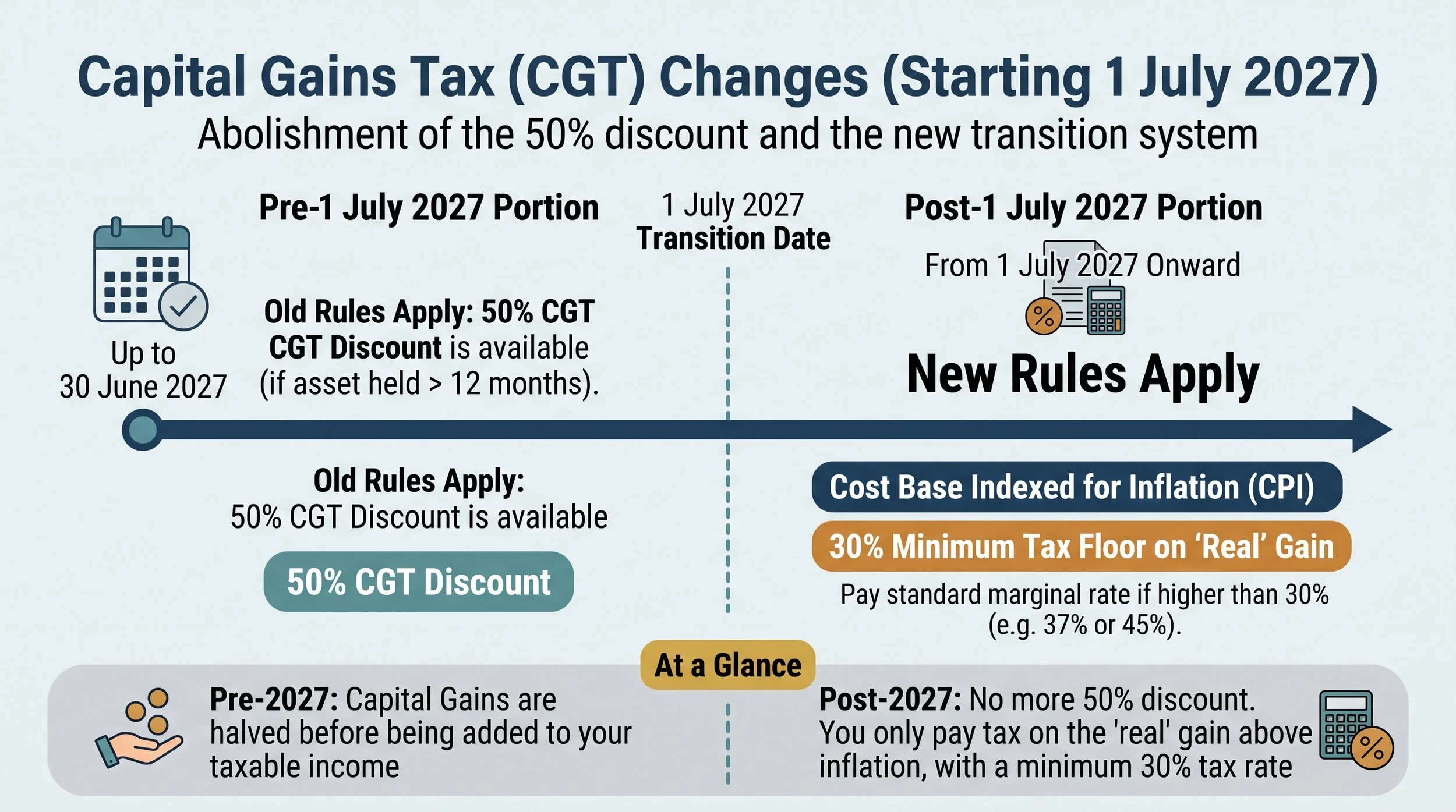
Starting 1 July 2027, the way tax is calculated on your property profits will change completely.
The Old Rule (Ending June 2027): If you hold the property for over a year, you receive a flat 50% discount on your taxable profit.
The New Rule (Starting July 2027): The 50% discount is abolished for individuals, trusts, and partnerships. Instead, your property's original cost base will be adjusted for inflation using the Consumer Price Index (CPI). You will only pay tax on the "real" profit above inflation.
The 30% Minimum Tax: This inflation-adjusted "real" profit will face a strict minimum tax rate of 30%. If your normal marginal tax bracket is below 30%, it will be brought up to 30% for the capital gain portion; if your marginal rate is already higher (e.g., 37% or 45%), you will pay your higher rate.
Key Summary Breakdown
| Feature | Old Rule (Ending 30 June 2027) | New Rule (Starting 1 July 2027) |
|---|---|---|
| Holding Perk | 50% Flat Discount on total taxable gain (if held > 12 months) | Abolished (replaced by CPI Indexation) |
| Cost Base | Purchase Price + Eligible Acquisition & Improvement Costs | Adjusted for Inflation (CPI) over the holding period |
| Taxable Profit | Total Gain halved before adding to income | Only "Real" Growth above CPI Inflation is taxed |
| Minimum Tax Floor | None (taxed at your standard marginal rate) | Strict 30% Minimum Tax Floor on the real gain |
| Higher Income Earners | Taxed at your marginal rate (e.g., 37% or 45%) | Taxed at your higher marginal rate (37% or 45%) |
3. The New Rules for Negative Gearing
How is negative gearing different?
Negative gearing concerns rental losses while you own a property. CGT concerns the profit when you sell it.
From 1 July 2027:
Negative gearing happens when your investment property costs more to run (mortgage interest, repairs, council rates, strata fees) than it generates in rental income. You are operating at a net rental loss.
Currently, the tax system allows you to take that financial loss and subtract it directly from your regular taxable income (like your day job's salary). This lowers your overall tax bracket and usually results in a larger tax refund at tax time.
The new laws fundamentally change this system to target tax benefits toward creating new housing supply rather than trading existing homes. Here is how the rules apply:
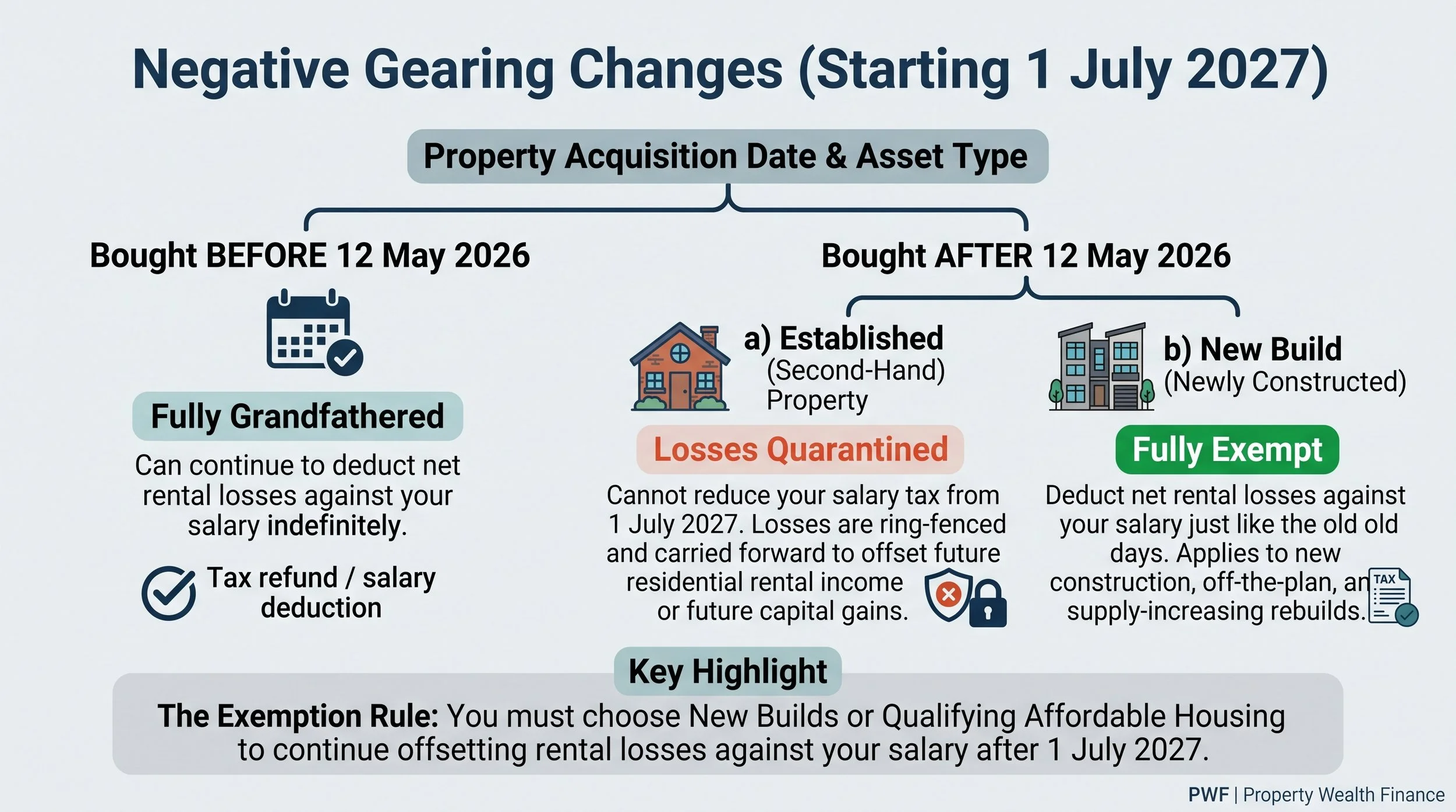
The Transition Window (Bought Between May 2026 and June 2027)
If you buy an established (second-hand) property after the budget announcement on 12 May 2026, but before 30 June 2027, you fall into a transition period:
You can negatively gear the property against your salary for the remainder of this window (e.g., in your 2026–2027 tax return).
Starting 1 July 2027, this benefit ends and your property becomes subject to "quarantining" rules.
What Happens on 1 July 2027: "Quarantining" Losses
From 1 July 2027, if you own an established property bought after the May 2026 cutoff:
You can no longer use the property's net rental loss to reduce the tax on your salary.
The losses are carried forward: Instead of disappearing, losses are ring-fenced to residential property income. You can use these accumulated losses to offset future net rental profits from any residential property, or subtract them from your final capital gain when you sell.
The "New Build" Exemption

To encourage new housing supply, the government has entirely exempted newly constructed housing from these restrictions. If you buy a new build, you can negatively gear it against your salary indefinitely, both before and after 1 July 2027.
What counts as a "New Build"?
A newly constructed house on previously vacant land.
An off-the-plan apartment or townhouse purchased from a developer.
A knock-down rebuild that results in a net increase in total housing supply (e.g., replacing 1 house with a duplex or multi-dwelling development).
What DOES NOT count as a "New Build"?
Substantial renovations or extensions to an existing house.
Adding a granny flat to your existing backyard.
A knock-down rebuild that replaces one old house with one single new house (no net increase in supply).
A newly built property that was occupied for more than 12 months prior to your purchase.
4. Are My Current Properties Safe? (Grandfathering)
You do not need to panic-sell your properties. The government included robust grandfathering rules to protect wealth built before the policy changes.
Negative Gearing: If you owned your property (or entered into an unconditional contract) before 7:30 pm AEST on 12 May 2026, you can continue to negatively gear it against your day-job salary for as long as you hold it.
Capital Gains Tax: The new indexation and 30% minimum tax rules only apply to property value growth that occurs after 1 July 2027. Any capital growth your property accumulated from its purchase date up to 30 June 2027 will still receive the old 50% CGT discount when you eventually sell.
5. The End of the "Pre-1985" Loophole
Historically, properties purchased before 20 September 1985 held a unique status: they were completely exempt from Capital Gains Tax. Every dollar of growth over the decades was yours to keep tax-free upon sale.
Under the new 2027 legislation, this long-standing tax exemption is coming to an end.
How the Pre-1985 Changes Work
The government is not retroactively taxing past wealth, but it is drawing a firm line in the sand as of 1 July 2027:
Past Growth Remains Tax-Free: All capital growth that occurred from the original purchase date up until 30 June 2027 remains 100% tax-free.
The "Reset" on 1 July 2027: On 1 July 2027, the ATO will treat the property as if it were "re-acquired" at its fair market value on that date. This value becomes your new baseline cost base.
Future Growth is Taxed: Any new capital growth generated between 1 July 2027 and the eventual sale date will be taxed under the new CGT rules (indexed for inflation, subject to the minimum 30% tax rate).
Essential Strategy for Pre-1985 Owners
If you or your family own a pre-1985 asset, obtaining an independent, formal market valuation close to 1 July 2027 is critical. Establishing a legally defensible valuation as of 1 July 2027 locks in the maximum tax-free baseline for the property's pre-2027 growth.
6. The Affordable Housing Exemption
To support the low-cost rental market, the government has created a dedicated exemption for investors who supply affordable housing.
If you rent your property out through an accredited Community Housing Provider (CHP) or under a recognised government affordable housing program, you bypass the new negative gearing restrictions entirely—even for established (second-hand) properties.
Key Benefits of the Affordable Housing Exemption
Full Negative Gearing Retained: You can continue to deduct 100% of your net rental losses directly against your day-job salary, regardless of when you bought the property or whether it is new or established.
Higher CGT Discount: Investors who dedicate a residential property to affordable housing for at least 3 years (1,095 days) remain eligible for an enhanced 60% CGT discount (compared to the standard 50% discount under the old system or the new indexation rules).
What Qualifies as "Affordable Housing"?
To access these exemptions, the property must meet criteria set by state and federal guidelines:
Below-Market Rent: The property must be rented at a discounted rate (typically at least 20% below the prevailing market rent for that area).
Eligible Tenants: Tenants must meet specific household income limits designed to assist low-to-moderate-income earners.
Registered Management: The property must be managed by a registered Community Housing Provider (CHP) or under a state-backed affordable housing scheme.
7. Case Studies: How It Works in Real Life
To understand how the new legislation plays out in practice, let’s walk through three distinct investor scenarios under the Treasury Laws Amendment (Tax Reform No. 1) Act 2026.
Scenario A: The Long-Term Investor (Bought in 2020)
The Situation:
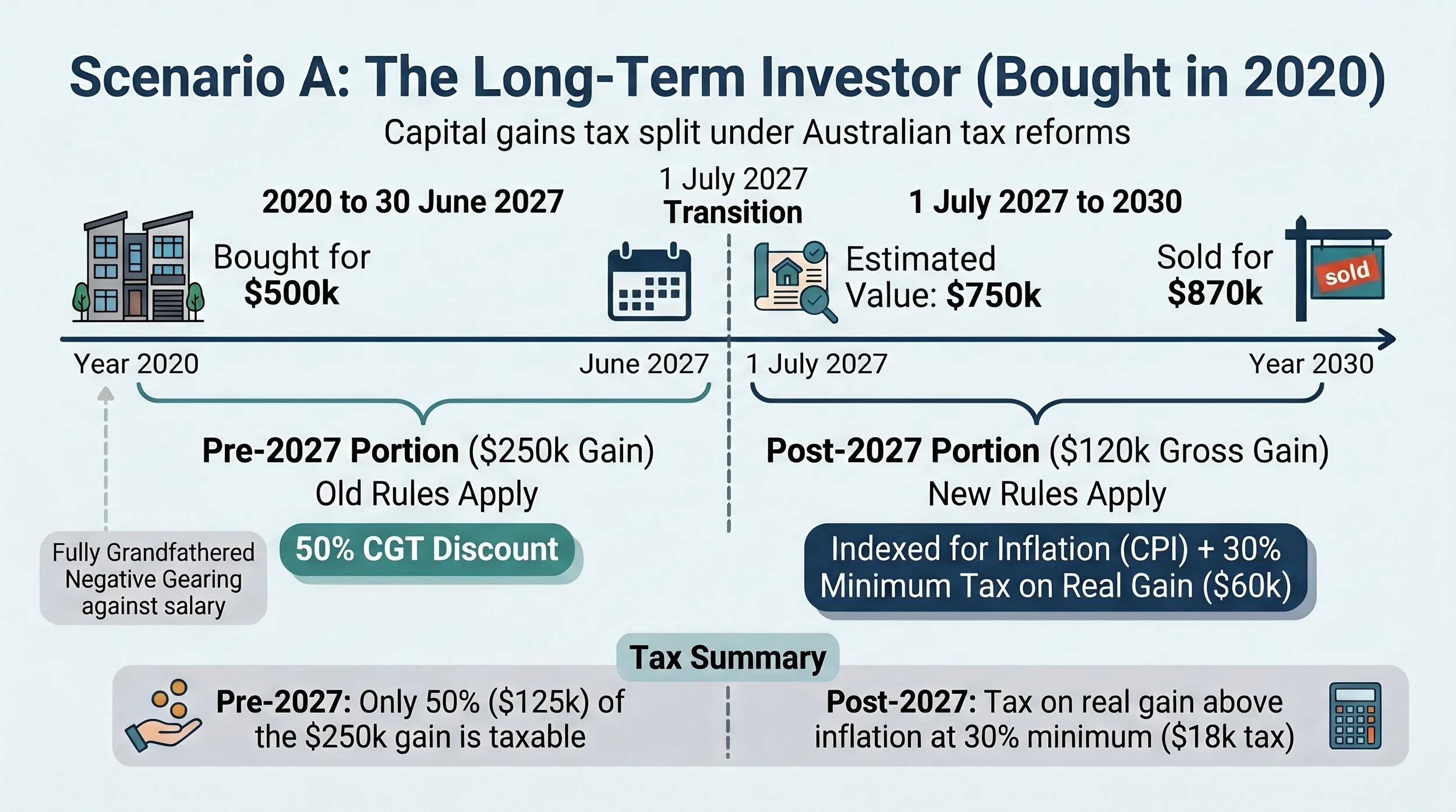
Jane bought an established two-bedroom apartment in Brisbane in mid-2020 for $500,000. It produces $25,000 per year in rental income but incurs $32,000 in annual holding costs (mortgage interest, council rates, strata fees), leaving her with a net annual loss of $7,000. She plans to sell the property in 2030.
1. Negative Gearing Outcome:
Because Jane purchased her property long before the 12 May 2026 cutoff, her investment is fully grandfathered. She can continue to deduct her $7,000 net annual loss directly against her day-job salary every year through to 2030, reducing her overall income tax bill as normal.
2. Capital Gains Tax (CGT) Outcome:
When Jane sells in 2030, her capital gain will be split into two distinct calculation periods using her property's valuation as of 1 July 2027:
Pre-2027 Portion ($250,000 Gain):
Her property grew from $500,000 to $750,000 between 2020 and 30 June 2027. Under the old rules, she receives the flat 50% CGT discount on this $250,000 gain. Only $125,000 is added to her taxable income.
Post-2027 Portion ($120,000 Gross Gain):
Between 1 July 2027 and 2030, the property grows from $750,000 to $870,000. Under the new rules, this $120,000 gain is indexed for inflation (assume CPI totals 8% over those 3 years, increasing her cost base to $810,000). Her "real" gain above inflation is $60,000 ($870,000 − $810,000), which is taxed at the new minimum 30% tax rate ($18,000 tax).
Scenario B: The Post-Budget Buyer (Bought in September 2026)
The Situation:
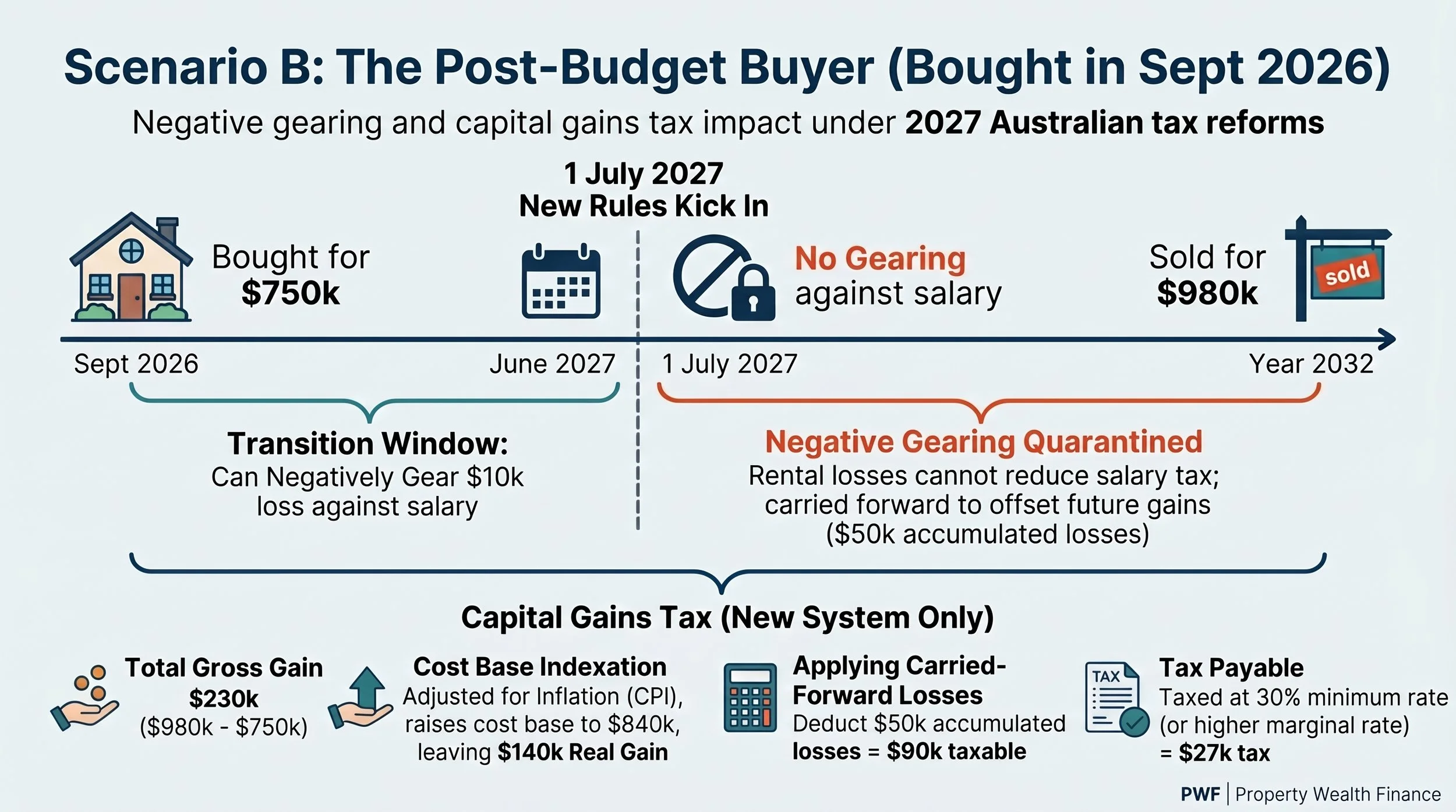
Mark bought an established four-bedroom house in Adelaide in September 2026 for $750,000. The property operates at an annual net loss of $10,000. He sells the property in 2032 for $980,000.
1. Negative Gearing Outcome:
Because Mark bought after the 12 May 2026 budget announcement, he gets a brief transitional window before loss ring-fencing kicks in:
2026–2027 Tax Year: Mark can deduct his $10,000 loss against his wage salary.
From 1 July 2027 Onward: His negative gearing is quarantined. He can no longer reduce his salary tax. His $10,000 annual losses accumulate (totaling $50,000 over 5 years) and are carried forward to offset future residential property profits or lower his final capital gain upon sale.
2. Capital Gains Tax (CGT) Outcome:
Because Mark acquired the asset after the May 2026 announcement, he does not qualify for the grandfathered 50% discount on any portion of his profit.
Total Gross Gain: $230,000 ($980,000 − $750,000).
Cost Base Indexation: Adjusting his $750,000 purchase price for cumulative CPI inflation (12% over 6 years) raises his cost base to $840,000.
Real Gain: $140,000 ($980,000 − $840,000).
Applying Carried-Forward Losses: Mark subtracts his $50,000 in accumulated, quarantined negative gearing losses from his real gain, leaving $90,000 in taxable profit.
Tax Payable: The remaining $90,000 is taxed at the minimum 30% rate (or his marginal rate if higher), resulting in a tax bill of $27,000.
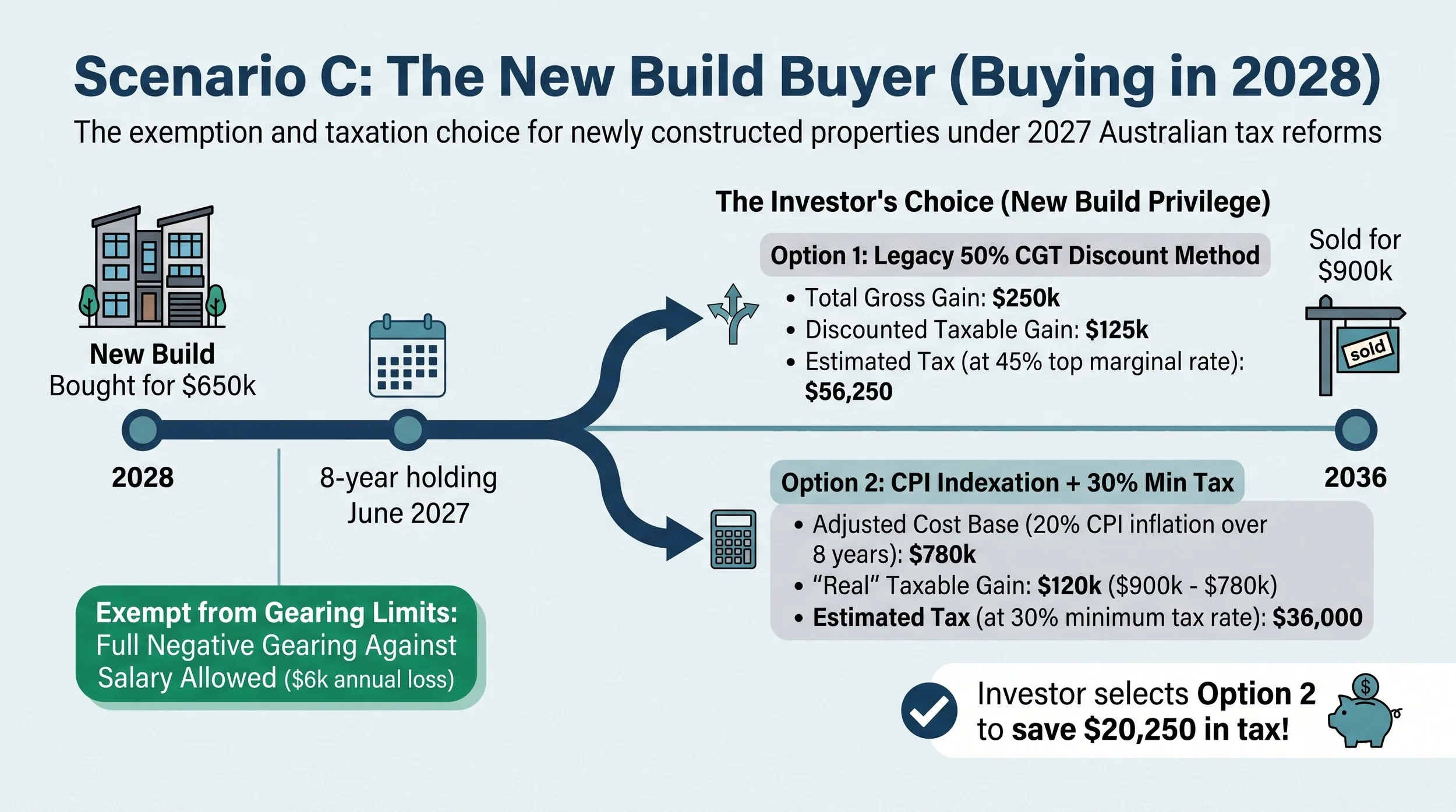
Scenario C: The New Build Buyer (Buying in 2028)
The Situation:
Sam purchases a brand-new, off-the-plan townhouse in Perth in early 2028 for $650,000. The property generates an annual net loss of $6,000. He sells it 8 years later in 2036 for $900,000.
1. Negative Gearing Outcome:
Because Sam purchased a newly constructed home, he is completely exempt from the negative gearing restrictions. He can deduct his $6,000 net rental loss against his day-job salary every single year without restriction, delivering an immediate tax refund each financial year.
2. Capital Gains Tax (CGT) Outcome:
As an incentive for investing in new residential housing supply, the government offers Sam a choice of CGT calculation methods upon sale:
Option 1 (50% CGT Discount): Total gain = $250,000 ($900,000 − $650,000). Applying the 50% discount leaves $125,000 added to his income. At a top marginal tax rate of 45%, the tax payable would be $56,250.
Option 2 (CPI Indexation): Assuming 20% cumulative CPI over 8 years, his indexed cost base increases to $780,000. Real gain = $120,000 ($900,000 − $780,000). At the 30% minimum tax rate, tax payable would be $36,000.
The Result: Sam chooses Option 2 (CPI Indexation) because it saves him $20,250 in tax compared to the 50% discount method.
8. Frequently Asked Questions
9. Your Strategy for a Better Future with Property Wealth Finance (PWF)
Navigating legislative changes while trying to build a profitable portfolio shouldn't be done in isolation. Most people manage their tax separately from their mortgage, investment strategy, and retirement plan.
At Property Wealth Finance (PWF), we provide the strategy for your better future by looking at the complete picture.
How PWF Helps You Win Under the New Rules
We do not just act as a buyer's agent or a mortgage broker—we build integrated wealth plans designed to optimise your tax, financing, and asset performance before you make a purchase.
Our comprehensive Wise Wealth Plan process includes:
Tax Minimisation Structuring: We integrate legal tax strategies—such as capitalising on the new build negative gearing exemptions, maximising depreciation, and setting up optimal ownership structures—directly into your portfolio model.
Finance & Cash Flow Optimisation: We work with a network of specialist brokers across 30+ lenders to restructure existing mortgages, reduce interest overheads, and unlock equity to ensure your portfolio remains cash-flow resilient.
Strategic Asset Selection: We identify high-growth, high-yield properties across Australia that fit your exact profile, emphasising new build opportunities where full tax perks are preserved.
End-to-End Execution & Ongoing Reviews: From acquisition to settlement, and through annual portfolio reviews, we partner with you for the long haul to adjust your strategy as tax laws and market conditions evolve.
Take Control of Your Financial Future Today
The 2027 tax changes present challenges, but also major opportunities for investors who act early and structure correctly.
Don't wait until the rules take effect to figure out your game plan.
Contact PWF today to speak with a consultant. We will help you analyse your current portfolio, identify tax risks, and map out a clear, actionable strategy to protect and grow your wealth for the future.
References & Official Sources
The information in this guide is derived from official legislation, treasury announcements, and Australian Taxation Office (ATO) guidance regarding the 2026–27 Federal Budget tax reforms:
Australian Taxation Office (ATO): Reforming negative gearing and capital gains tax (2026–27 Measures) — Guidance on the passage of the Treasury Laws Amendment (Tax Reform No. 1) Act 2026, outlines commencement dates, CPI indexation guidelines, and transitional valuation rules as of 1 July 2027.
The Treasury (Commonwealth of Australia): Negative Gearing and Capital Gains Tax Reform Factsheet — Technical specifications for the 30% minimum capital gains tax rate, negative gearing loss quarantining rules, affordable housing exemptions, and new-build incentives.
Federal Register of Legislation: Treasury Laws Amendment (Tax Reform No. 1) Act 2026 — Explanatory Memorandum and legislative text governing pre-1985 asset transitional rules, trust distribution withholding requirements, and grandfathering conditions for existing property contracts.
Australian Bureau of Statistics (ABS): Consumer Price Index (CPI), Australia — Official indexation benchmark used for calculating post-2027 adjusted property cost bases.
Legal & Financial DisclaimerGeneral Advice Warning: The information provided in this guide is general in nature and is intended solely for educational and informational purposes. It does not constitute personal financial, taxation, accounting, or legal advice. This content has been prepared without taking into account your personal objectives, financial situation, tax bracket, or specific investment needs.No Certified Financial Advice: Property Wealth Finance (PWF) and its authors are not licensed tax agents, certified practicing accountants (CPAs), or financial advisers, and this material should not be relied upon as a substitute for professional legal or tax advice. Australian tax laws (including Capital Gains Tax, negative gearing regulations, and trust distribution rules) are complex, subject to ongoing legislative changes, and vary significantly based on individual circumstances, property ownership structures, and residency status.Seek Professional Advice: Before making any financial decision, acquiring or disposing of real estate, or altering your investment strategy, you should seek independent advice from a qualified, registered Tax Agent, Certified Practicing Accountant (CPA), or licensed Financial Planner who can assess your specific personal and financial situation.