
From One Investment Property to a $3.6 Million Portfolio: A 10-Year Wealth Creation Journey
How a clear long-term strategy helped one couple build towards their early retirement goals
When Michael and Sarah first came to PWF in 2015, they already owned one investment property.
They had taken the first step towards building wealth through property, but they knew they needed a clear strategy to determine what came next.
Their goal was ambitious but specific: to build a portfolio that could support an early retirement in 2036, with a target passive retirement income of $100,000 per year and more than $2 million in net investment assets.
Rather than simply acquiring more property, the focus was on developing a long-term wealth creation strategy that balanced equity, borrowing capacity, cash flow and the right property selection.
Ten years later, their portfolio has grown significantly — and they have now completed the acquisition phase of their strategy.
The Starting Point
When Michael and Sarah attended a PWF wealth creation seminar in 2015, they already owned one residential investment property.
They had equity available in their existing property, but the key question was how that equity could be used effectively without putting unnecessary financial pressure on their household.
Their objectives were clear:
Retire early in 2036
Target a passive retirement income of $100,000 per year
Build net investment assets of more than $2 million
Use property as a long-term wealth creation vehicle
Maintain manageable cash flow throughout the investment journey
The strategy therefore wasn't about simply buying as many properties as possible.
It was about buying the right properties, at the right time, within a sustainable financial structure.
Building the Strategy Around Their Financial Position
A successful property investment strategy needs to account for more than property values.
For Michael and Sarah, an important part of the process was managing the relationship between equity and serviceability.
Equity can provide the capacity to acquire additional assets, but borrowing capacity and ongoing cash flow ultimately determine whether an investment strategy remains sustainable.
This meant carefully considering:
How much equity was available?
How much could they comfortably borrow?
What would the ongoing cash flow look like?
How could the portfolio continue to grow without creating unnecessary financial stress?
Getting the finance structure right was particularly important because strong ongoing cash flow can provide greater flexibility as a portfolio develops.
The objective was to build a portfolio that worked as a whole — rather than making isolated property decisions.
Three More Properties Over 10 Years
Over the following decade, Michael and Sarah acquired three additional residential investment properties through PWF.
That brought their total investment property portfolio to four properties.
Importantly, the acquisitions were spread across the 10-year period rather than being driven by a desire to build the portfolio as quickly as possible.
Each acquisition formed part of the broader wealth creation strategy.
Today, the acquisition phase of their plan is complete.
The strategy now shifts from building the portfolio to allowing time, market growth and disciplined ownership to do the heavy lifting.
The Numbers Today
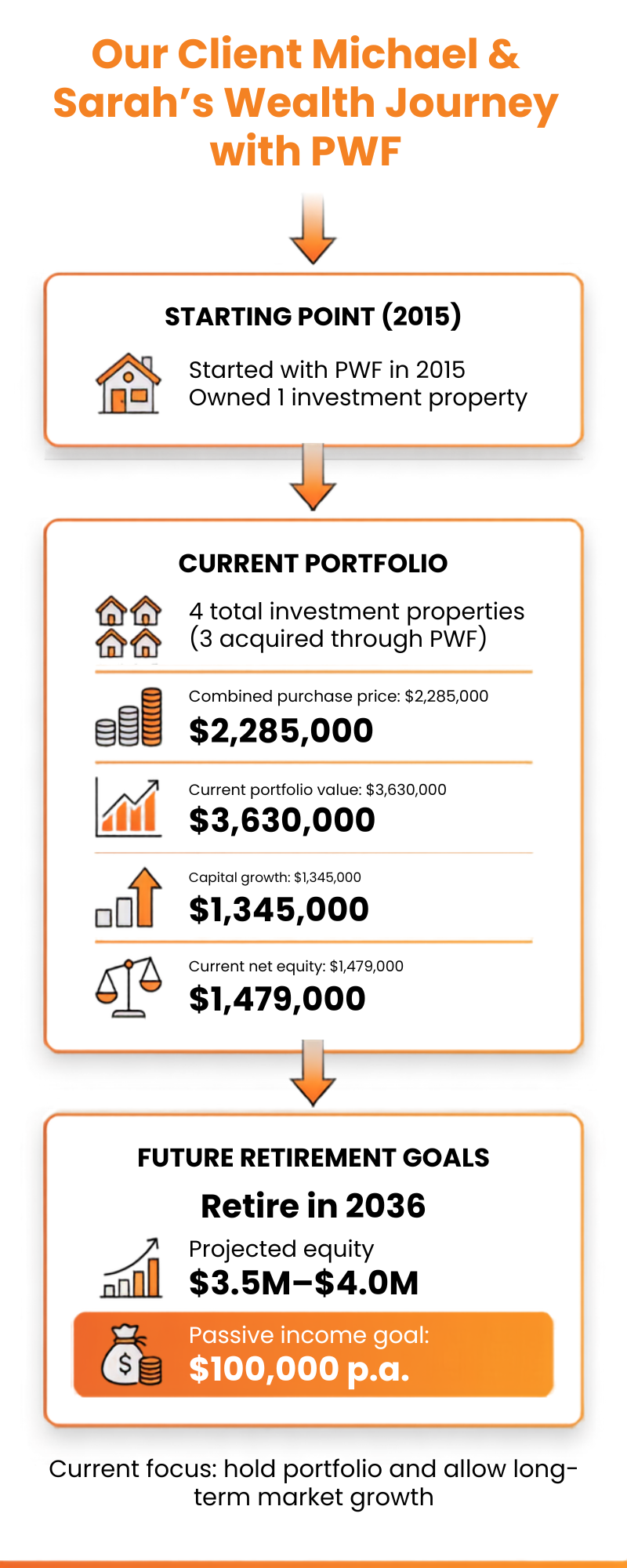
At their most recent annual review, the portfolio had experienced substantial growth.
The properties were valued at a combined $3.63 million.
That represents approximately $1.345 million in gross capital growth from the combined contract prices.
After accounting for their investment debt, the portfolio currently holds approximately $1.479 million in net equity.
But for Michael and Sarah, today's numbers are only one part of the story.
The real objective is what the portfolio could help them achieve over the next decade.
From Building to Consolidating
With approximately 10 years remaining until their planned early retirement, Michael and Sarah have now completed their planned acquisition phase.
This is an important transition.
The strategy isn't necessarily about continuing to buy indefinitely.
Instead, the focus is now on managing and monitoring the existing portfolio while allowing the assets and market to potentially continue building their wealth over time.
Based on current projections, their anticipated equity position at retirement is expected to sit comfortably between $3.5 million and $4 million, subject of course to future property values, debt levels, market conditions and other variables.
The goal is to arrive at retirement with a substantial asset base capable of supporting their desired lifestyle.
The Importance of Annual Reviews
One of the most important parts of a long-term wealth creation strategy is recognising that the plan doesn’t stop after a property is purchased.
Circumstances change.
Income changes.
Property values change.
Interest rates change.
Borrowing capacity changes.
Personal goals change.
Markets change.
That’s why PWF’s Wise Wealth Plan includes ongoing support and annual reviews to ensure the strategy continues to evolve with you.
For Michael and Sarah, these reviews provide an opportunity to assess where they are today compared with where they intended to be when their strategy began.
“At PWF, we view property investment as a long-term wealth creation strategy—not a series of disconnected property purchases.
A successful portfolio needs to evolve with your financial position, market conditions and long-term goals. As your circumstances change, so should your strategy.
Our focus is on building the right portfolio, at the right time, with each investment playing a clear role in moving you closer to your desired financial future.”
The review process considers the performance and position of their portfolio, available equity, debt and cash flow, and whether the overall strategy remains aligned with their longer-term objectives.
It also helps determine whether the next step should be to acquire another asset, consolidate, restructure or simply allow the existing portfolio more time to mature.
This is the value of the Wise Wealth Plan — it’s not simply about purchasing property; it’s about continually reviewing, refining and managing the strategy as circumstances change.
In their case, the conclusion was clear: the acquisition phase was complete.
Now, their strategy is focused on allowing their existing portfolio to mature, while continuing to review their position and make informed adjustments as needed on the journey towards their 2036 retirement goal.
Experience the PWF Difference
Michael and Sarah’s journey demonstrates what can happen when property investment is supported by a structured, long-term wealth creation strategy.
At PWF, we combine strategy, research, property selection, finance and ongoing support to help clients make informed decisions at every stage of their wealth creation journey.
Disclaimer:
This case study is based on the experience of PWF clients and is provided for educational purposes only. Past property performance and historical growth do not guarantee future results. Property values, rental income, borrowing capacity and investment outcomes can vary, and individual results will depend on personal circumstances, market conditions and the properties selected. PWF does not provide tax or financial advice.