
Stocks vs Property: Which Investment Could Build More Wealth?
How Property and Shares Compare — and How Leverage Can Change the Return
For decades, Australians have debated the merits of property versus shares.
Both asset classes have created significant wealth.
Both have generated long-term returns.
Both have a place within a diversified investment strategy.
Yet when it comes to building substantial wealth, creating financial freedom and accelerating retirement outcomes, residential property has consistently remained one of Australia's most powerful investment vehicles.
This is not simply because property prices rise.
It is because property combines multiple wealth-building advantages that few other investments can offer simultaneously:
Leverage
Rental income
Equity creation
Tax efficiencies
Inflation protection
Strong long-term demand fundamentals
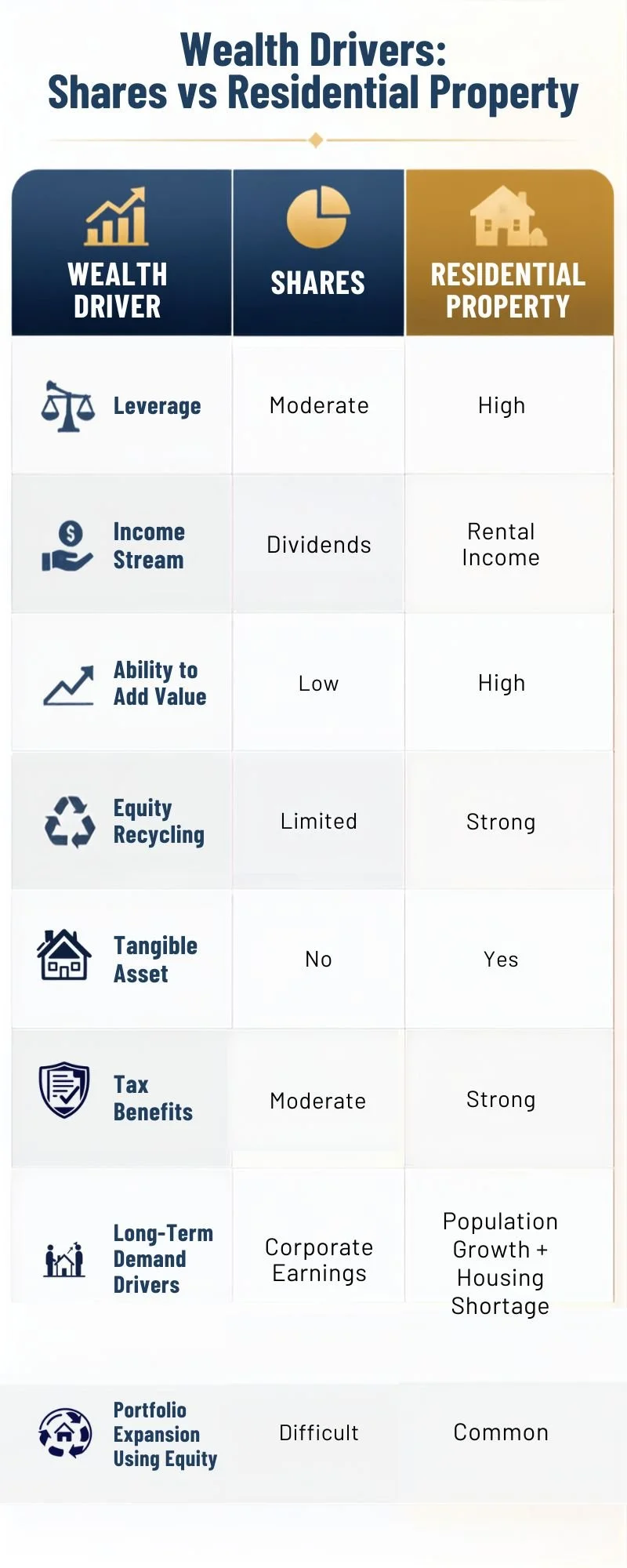
The ability to build a portfolio using accumulated equity
When these factors work together over time, they can create a powerful compounding effect that has helped millions of Australians build wealth.
Property Allows You to Control a Large Asset With a Small Deposit
The greatest advantage property has over most other investments is leverage.
Leverage allows investors to use borrowed money to control a much larger asset than they could otherwise afford.
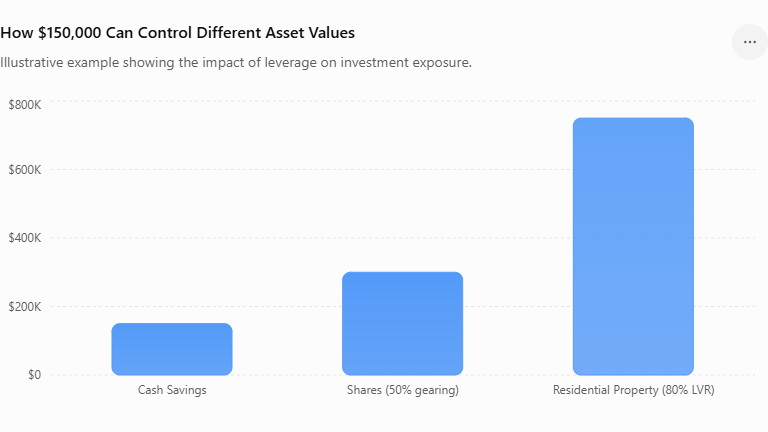
For example, an investor with $150,000 (savings or available equity) may be able to purchase a property worth approximately $750,000 using an 80% loan.
That same investor may only be able to obtain around $300,000 of total market exposure through a geared share portfolio.
The result is simple:
The property investor has a significantly larger asset working on their behalf from day one.
This is one of the reasons property has historically been such a powerful wealth creation tool.
The growth occurs on the entire asset value, not just the investor's initial contribution. As demonstrated earlier in this article, the same $150,000 can potentially control an asset worth 2.5 times more in residential property than in a typical geared share portfolio.
Property Benefits From Australia's Long-Term Housing Shortage
One of the strongest investment themes in Australia is housing supply.
Australia continues to face a structural shortage of housing.
The Federal Government's National Housing Accord aims to deliver 1.2 million new homes by 2029, yet construction activity remains well below the level required to achieve that target. Labour shortages, rising construction costs and approval delays continue to restrict new supply.
At the same time:
Australia's population continues to grow.
Household formation continues to increase.
Migration remains a major source of housing demand.
More Australians are living in smaller households, increasing demand for additional dwellings.
In any market, when demand consistently outpaces supply, prices tend to rise over the long term.
This fundamental supply-and-demand imbalance remains one of the strongest long-term tailwinds supporting Australian residential property.
Property Creates Multiple Sources of Return
Many investments rely on a single source of return.
Property can generate wealth from several sources simultaneously.
Capital Growth
As property values increase over time, investors build equity through capital appreciation.
Rental Income
Investment properties can generate ongoing rental income that may contribute towards holding costs, interest expenses and cash flow requirements.
Debt Reduction
As tenants contribute rent and loans are repaid, debt levels can reduce while ownership equity increases.
Equity Creation
Growth plus debt reduction creates additional equity that can potentially be used to fund future investments.
This combination of growth, income and equity creation is one of the reasons property portfolios can accelerate wealth creation over long periods.
Australian Property Has Created Enormous Wealth
Residential property is one of Australia's largest asset classes.
According to the Australian Bureau of Statistics, the total value of Australia's residential housing stock reached approximately $12.8 trillion in March 2026, increasing by more than $315 billion in a single quarter. The average dwelling value nationally exceeded $1.11 million, highlighting the enormous scale of wealth held in Australian residential property.
Property is not a niche investment.
It is one of the largest stores of wealth in the Australian economy.
The scale of this market has allowed generations of Australians to build substantial net worth through long-term ownership.
Property Has Delivered Competitive Long-Term Returns
One of the biggest misconceptions is that shares always outperform property.
The evidence suggests the answer is more nuanced.
CoreLogic (now Cotality) analysis found that when both capital growth and rental income are included, Australian residential property delivered cumulative total returns of approximately 132.6% over the decade to 2024, slightly ahead of the Australian share market's 126.4% total return over the same period. Housing also outperformed equities in six of those ten years.
Importantly, these comparisons are before considering the impact of leverage.
Because investors can generally borrow significantly more against residential property than shares, the return achieved on invested equity can be materially different.
This is one of the primary reasons many wealth creation strategies continue to favour property as a core asset.
Property Generates Equity That Can Be Reinvested
Property investors often benefit from something many other investors overlook:
The ability to recycle equity.
As a property increases in value, investors may be able to access part of that equity to fund additional investments.
This creates a powerful compounding effect.
Instead of saving an entirely new deposit from income, investors may use accumulated equity to:
Purchase additional properties
Reduce non-deductible debt
Diversify investments
Improve cash flow
Accelerate wealth creation
Many successful investors have built substantial portfolios through this process of strategic equity utilisation.
Property Is a Tangible Asset
Unlike shares, property is physical.
You can inspect it.
Improve it.
Renovate it.
Develop it.
Add value to it.
Investors often appreciate having direct influence over the performance of their investment.
A renovation, subdivision, granny flat, cosmetic upgrade or development opportunity can create value that may not otherwise exist.
This level of control is difficult to replicate with many other investment assets.
Property Can Provide Valuable Tax Benefits
Property investing may provide several tax advantages depending on an investor's circumstances.
These can include:
Interest deductibility
Depreciation allowances
Ownership expense deductions
Capital gains tax concessions
Negative gearing benefits where applicable
The Reserve Bank of Australia notes that investment property remains a significant part of Australia's financial system, with approximately 3.3 million Australians holding investment property interests. Most investors own a single investment property, while a smaller group of multi-property investors hold a substantial proportion of investment housing stock.
Tax benefits alone should never drive an investment decision.
However, when combined with strong asset selection and a long-term strategy, they can improve after-tax outcomes.
Property Encourages Long-Term Investing
One of the greatest threats to investment success is investor behaviour.
People often buy high and sell low.
They react emotionally to market movements.
They panic during downturns.
Property's lower liquidity can actually be an advantage.
Unlike shares, which are repriced every second during market hours, property values are not constantly displayed on a screen.
Investors are less likely to react emotionally to short-term volatility.
This often encourages a longer investment horizon, allowing time and compounding to work in their favour.
Property Is Not About Getting Rich Quickly
The most successful property investors understand that property is not a speculative vehicle.
It is a long-term wealth creation strategy.
The objective is not simply to buy a property.
The objective is to:
Build equity
Increase net worth
Improve cash flow
Create future investment opportunities
Generate retirement income
Achieve financial independence
Property rewards patience, discipline and strategic planning.
Those who approach property with a long-term mindset often place themselves in a stronger position to benefit from compounding growth, equity creation and increasing asset values over time.
The PWF Perspective
At PWF, we believe the real power of property is not the property itself.
It is the strategy behind it.
Property can provide leverage.
Property can create equity.
Property can generate rental income.
Property can help accelerate wealth creation.
But without a clear strategy, even a good property may fail to achieve its full potential.
That is why every successful portfolio starts with a plan.
“Wealth creation is not about making one big investment decision. It is about creating a strategy where each step strengthens the next — from income and borrowing capacity, to property acquisition, capital growth and equity creation. Over time, that equity can help expand your portfolio and move you closer to genuine financial freedom.
Income → Borrowing Capacity → Property Acquisition → Capital Growth → Equity Creation → Portfolio Expansion → Financial Freedom”
A Wise Wealth Plan considers:
Your income
Existing assets
Borrowing capacity
Debt structure
Cash flow position
Tax considerations
Retirement goals
Future investment opportunities
Because ultimately, wealth is not created by owning a property.
Wealth is created by owning the right assets, using the right structure, with the right strategy, over a long period of time.
And for many Australians, residential property continues to be one of the most effective vehicles available to achieve that outcome.
Ready to Build Your Property Wealth Strategy?
Property investing is not about simply buying a property. It is about having the right strategy, selecting the right opportunities and understanding how each investment can contribute to your long-term wealth goals.
Book a complimentary Property Wealth Strategy Session with PWF and speak with our experienced team about your current position, borrowing capacity and potential next steps.
Let’s turn your property goals into a clear, strategic plan!
→ Book Your Appointment with PWF
References:
Australian Bureau of Statistics (ABS) – Total Value of Dwellings, March 2026
Australian residential property value exceeding $12.8 trillion.
Average dwelling value above $1.11 million.
Reserve Bank of Australia (RBA) – Insights from New Data on Australian Housing Investors (2026)
Analysis of investor behaviour, borrowing patterns, leverage and investment property ownership in Australia.
CoreLogic (Cotality) Housing Market Research
Long-term comparison of residential property and share market returns.
Housing total returns versus Australian equities over the past decade.
National Housing Accord & Housing Supply Research
Australian Government housing targets.
Housing supply shortages and construction challenges impacting future dwelling availability.
Australian Property Market Historical Data
Long-term dwelling value growth trends.
Population growth and housing demand analysis.
PWF Internal Research and Client Portfolio Analysis
Wealth creation modelling.
Equity growth projections.
Borrowing capacity and portfolio-building strategies.
Disclaimer: Past performance is not a reliable indicator of future performance. Property values, rental returns, interest rates and investment outcomes can vary. This article is general information only and should not be considered personal financial advice.