
Negative Gearing, Depreciation and CGT: Three Potential Tax Advantages of Investing in New Property
When you invest in property, the rent you receive and the price you eventually sell for are only part of the financial picture. Tax treatment can also influence what the investment costs you each year and how much of your gain you keep when you sell.
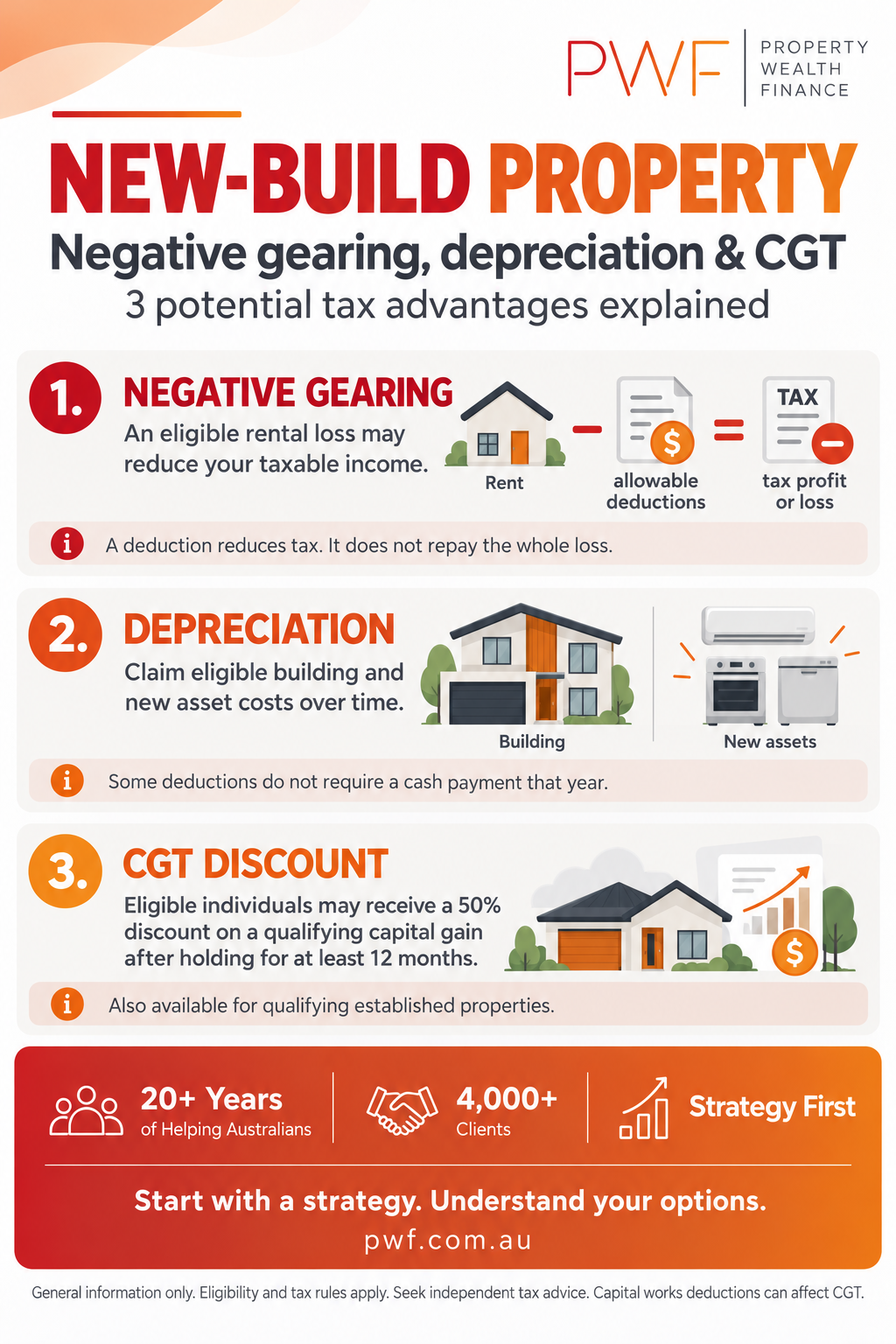
For eligible new-build investment properties, three potential tax advantages deserve attention:
1. Access to negative gearing benefits.
2. Depreciation deductions for eligible construction costs and new assets.
3. Continued access to the 50% capital gains tax discount, subject to eligibility.
The 2026–27 Federal Budget reforms make the distinction between new and established properties particularly relevant. From 1 July 2027, eligible new builds retain important tax options that will generally be restricted for established properties acquired after the Budget announcement.
These are potential advantages, rather than three brand-new incentives. Depreciation already exists, while the reforms preserve negative gearing and the CGT discount option for qualifying new builds.
At Property Wealth Finance (PWF), we believe understanding these rules should help you make a clearer decision. The starting point is your goal, followed by a strategy that considers income, costs, finance, tax and long-term growth.
At a glance: the three potential advantages
| Tax advantage | What it can mean for an eligible new-build investor | When it matters |
|---|---|---|
| Negative gearing | An allowable net rental loss can reduce other taxable income, such as salary and wages. | During ownership, when the investment makes a tax loss. |
| Depreciation | Eligible construction expenditure and new assets can generate deductions over time. | During qualifying income-producing use. |
| CGT discount | Eligible investors retain the option to discount a qualifying capital gain by 50%. | When the investment is sold or another relevant CGT event occurs. |
Treasury sets out the new-build treatment for negative gearing and CGT. The ATO explains the existing rules for construction and asset deductions.
1. Negative gearing: retained access for eligible new builds
Negative gearing occurs when your allowable rental deductions exceed your rental income.
For example, deductible interest, operating expenses and eligible depreciation may together be greater than the rent received. Where the rules allow, that net rental loss can reduce your other taxable income.
Under the reforms starting on 1 July 2027, eligible new-build investors can continue to use rental losses against other income, including salary and wages.
Established properties acquired after 7:30 pm AEST on 12 May 2026 will generally have their rental losses restricted to residential property income from that commencement date, with unused losses carried forward. Properties held before the cut-off retain their existing negative gearing treatment. [1][3]
A simple example
Assume an eligible investor receives $35,000 in annual rent and has $43,000 in allowable rental deductions.
| Item | Annual amount |
|---|---|
| Rental income | $35,000 |
| Allowable rental deductions | $43,000 |
| Net rental loss for tax purposes | $8,000 |
If the full deduction reduces income otherwise taxed at 30%, the illustrative income-tax reduction is:
$8,000 × 30% = $2,400
This example ignores Medicare levy, offsets and other tax effects.
The deduction is $8,000. The tax saving is $2,400. The government does not reimburse the entire loss.
Why cash flow and taxable income are different
A tax loss is not always the same as a cash loss.
Depreciation is a deduction that does not require an equivalent cash payment in the year it is claimed. As a result, an investment can have positive cash flow before tax and still show a rental loss for tax purposes.
The reverse also matters. Some cash payments, such as principal repayments on a loan, are not ordinary rental deductions.
To assess affordability, you need both a cash-flow forecast and a tax calculation. Looking at one alone can give an incomplete picture.
2. Depreciation: deductions for the building and new assets
Depreciation is an existing feature of property taxation. It is not a new benefit introduced by the 2026–27 Budget.
For a qualifying new rental property, deductions commonly fall into two categories: capital works and depreciating assets.
Capital works: eligible construction expenditure
Capital works deductions cover qualifying building and structural expenditure. For ordinary eligible residential construction, the deduction is generally 2.5% a year over 40 years.
The deduction relates to eligible construction expenditure, not the full purchase price. Land is not depreciable, and construction must be complete before these deductions start. Claims also depend on qualifying rental use. [2][4]
For example:
| Item | Amount |
|---|---|
| Assumed eligible construction expenditure | $300,000 |
| Illustrative annual deduction rate | 2.5% |
| Full-year capital works deduction | $7,500 |
This is an illustration, not an estimate for a particular PWF property. Actual eligible costs and the claimable period need to be established.
Depreciating assets: new equipment and fittings
Separate deductions may be available for eligible new assets, such as air conditioners and appliances. Their deductions depend on the applicable method, effective life and use.
Restrictions generally apply to many second-hand assets acquired with established residential rental properties. This can make the availability of deductions for new assets an advantage of a new build. [2]
However, established properties can still have eligible capital works deductions and deductions for new assets installed by the investor. Depreciation is not exclusive to new builds.
What does a deduction mean in dollars?
Assume your eligible capital works and asset deductions total $10,000 for the year.
If that entire deduction reduces income otherwise taxed at 30%, the illustrative income-tax reduction is:
$10,000 × 30% = $3,000
A $10,000 deduction is not a $10,000 refund. Your actual result depends on your income, allowable claims and other tax circumstances.
Getting the calculation right
A depreciation schedule can help identify eligible construction costs and assets and allocate deductions over time. A suitably qualified quantity surveyor may assist with construction-cost estimates, while your accountant determines the claims that apply to your circumstances.
Keep purchase documents, construction information, invoices and records of rental use. These support both annual deductions and the eventual sale calculation.
3. CGT: eligible new builds retain a discount option
Capital gains tax applies to taxable gains made when you sell an investment property or another relevant CGT event occurs.
A simplified property calculation is:
Sale proceeds − adjusted cost base = capital gain
The cost base may include eligible acquisition, improvement and disposal costs, with required adjustments.
A new-build investment property is not automatically exempt from CGT.
What is retained under the reforms?
For eligible new-build investors, the reforms preserve a choice when selling:
· The 50% CGT discount.
· The new inflation-based arrangements, including the minimum tax on real gains.
The general reforms apply to gains accruing from 1 July 2027. Eligibility for the new-build discount option depends on the legislation, the ownership structure and the usual discount requirements. [1][5]
For eligible Australian resident individuals, the discount generally requires holding the asset for at least 12 months. Companies cannot claim the ordinary 50% CGT discount. [6]
A simple sale example
Assume an eligible individual qualifies for the 50% discount and has no capital losses. The adjusted cost base below already includes all required adjustments.
| Item | Amount |
|---|---|
| Sale proceeds | $800,000 |
| Adjusted cost base | $640,000 |
| Capital gain | $160,000 |
| Gain included in taxable income after the 50% discount | $80,000 |
The $80,000 is the amount included in taxable income, not the tax bill.
Your actual tax depends on your circumstances and applicable tax rates. If the inflation-based option is also available, your adviser can compare the two methods.
How the three benefits work together
These tax features operate at different stages, but they interact.
During ownership, eligible depreciation contributes to your rental deductions. If total deductions exceed rent, they may produce a net rental loss that can be used under the applicable negative gearing rules.
When you sell, the CGT calculation considers the gain and any available concessions.
Depreciation and negative gearing are not two separate refunds. Depreciation is part of the calculation that determines your taxable rental result.
The link between building deductions and CGT
Capital works deductions generally reduce the property's cost base, which can increase the capital gain when it is sold. [7]
For illustration, if a $640,000 cost base needs to be reduced by $30,000 in capital works deductions, the adjusted cost base becomes $610,000. At an $800,000 sale price, the gain would be $190,000 before capital losses and any available discount.
This does not automatically make the deductions unattractive. It means annual tax outcomes and the eventual sale outcome should be considered together.
Does every newly built property qualify?
Do not assume that a property qualifies for every tax concession simply because it is described as “new” in marketing material.
The legislation defines a new residential dwelling and provides rules for particular circumstances. Your acquisition arrangements and ownership structure need to satisfy the relevant requirements. [5][8]
Before committing, ask your adviser to confirm:
· Whether the particular property qualifies for the new-build provisions.
· Whether your proposed ownership structure can access the relevant benefits.
· When the property will be completed and available for rent.
· What construction and asset deductions are supportable.
· How a future sale would be treated.
Buying personally, through a company, a trust or an SMSF can produce different outcomes. The examples in this article should not be applied automatically to every structure.
A tax advantage should support a sound investment
Tax benefits can improve an after-tax result, but they do not guarantee a profitable investment.
A property assessment should also consider:
| Factor | Question to ask |
|---|---|
| Rental demand | Is there evidence that tenants want this type of property in this location? |
| Rental income | Are the expected rent and vacancy assumptions realistic? |
| Ongoing costs | Have insurance, management, maintenance, rates and other expenses been allowed for? |
| Finance | Can you afford repayments and withstand higher rates or periods without rent? |
| Construction | What are the completion, contract and delivery risks? |
| Growth potential | Does the location have credible long-term demand drivers? |
| Exit plan | What would selling costs and tax mean for the amount you retain? |
A larger deduction does not necessarily mean a better investment. The outcome that matters is how the property performs after costs and tax, and whether it helps you achieve your goal.
Start with your goal, then build the strategy
At Property Wealth Finance, our focus is helping clients connect new-property investment decisions with their financial goals.
For one household, that may mean exploring ways to reduce their home mortgage. For another, it may mean building income, preparing for retirement or creating more options for their family.
Our Income → Growth → Duplication framework provides a way to consider the role of income today, potential growth over time and future investment opportunities as circumstances allow. Outcomes depend on the property, finance and market conditions.
Tax considerations belong within that broader plan. A worthwhile strategy should show both the potential advantages and the practical commitments required to pursue them.
Explore how new-property investing could fit your circumstances
Eligible new builds can combine access to negative gearing, depreciation deductions and the retained CGT discount option.
Understanding those features can help you assess opportunities with greater clarity. The next step is to look at your goals, borrowing position, household budget and investment time frame together.
Book an obligation-free conversation with PWF to explore how a new-property investment strategy could fit your circumstances.
Work with your accountant or registered tax adviser to confirm eligibility and your personal tax outcomes before acting.
Frequently asked questions
Q1: Are all three benefits new Budget incentives?
No. Depreciation is an existing deduction framework. The reforms preserve access to negative gearing and a CGT discount option for eligible new builds.
Q2: Can a new build be cash-flow positive and negatively geared?
Potentially. Eligible non-cash deductions can create a tax loss even when rent exceeds cash expenses. The actual result depends on the full cash-flow and tax calculations.
Q3: Does the 50% CGT discount mean I pay 50% tax?
No. It generally reduces an eligible capital gain by half after relevant capital losses. The remaining amount is included in taxable income.
Q4: Can I claim deductions for the entire purchase price?
No. Land is not depreciable. Construction and asset deductions require eligible expenditure, appropriate calculations and qualifying use.
Q5: Does new construction guarantee a better investment?
No. Tax treatment is one consideration alongside price, rent, costs, finance, location, construction risks and your goals.
Information current as at 12 October 2026. This article provides general information only and is not personal financial, legal or tax advice. Examples are illustrative and do not represent a specific property or promised return. Eligibility and outcomes depend on your circumstances and applicable legislation.
Sources
1. Australian Treasury — Budget 2026–27 tax system changes: https://treasury.gov.au/policy-topics/taxation/budget2026-27
2. Australian Taxation Office — Rental properties guide 2025: https://www.ato.gov.au/law/view/document?LocID=%22SAV%2FRENTAL%2FATTRAVELANDCAREXPENSES%22&PiT=99991231235958
3. Australian Government — Budget tax explainer, negative gearing and CGT reform: https://budget.gov.au/content/factsheets/download/tax-explainers-negative-gearing-capital-gains-tax.pdf
4. Australian Taxation Office — Guide for rental property owners: https://www.ato.gov.au/law/view/pdf/sos/rental20180701.pdf
5. Treasury Laws Amendment (Tax Reform No. 1) Act 2026: https://www.legislation.gov.au/C2026A00049/asmade/2026-06-26/text/original/epub/OEBPS/document_1/document_1.html
6. Australian Taxation Office — About CGT concessions: https://www.ato.gov.au/Forms/Guide-to-CGT-concessions-for-small-business-2009--10/?page=5
7. Australian Taxation Office — Rental properties 2024, cost base adjustments: https://www.ato.gov.au/law/view/document?LocID=%22SAV%2FRENTAL%2FATEXPENSESCLAIMANIMMEDIATEDEDUCTION%22&PiT=20230701000001
8. Treasury Laws Amendment (Tax Reform No. 3) Act 2026: https://www.legislation.gov.au/C2026A00071/asmade/2026-08-26/text/original/epub/OEBPS/document_1/document_1.html
Disclaimer: This article provides general information only and does not constitute financial, investment, legal or tax advice. It does not take into account your personal objectives, financial situation or needs. Tax benefits depend on your circumstances, eligibility and applicable laws, which may change. Seek independent advice from a qualified financial adviser and registered tax agent before making investment decisions.