
Negative Gearing Is Not Dead: How New Property Investments Could Still Help Reduce Tax and Build Wealth
If you've been following the headlines, you may have heard that negative gearing is "dead."
The reality is far more nuanced.
While the Federal Government has announced significant changes to negative gearing rules, investors purchasing eligible new-build residential properties can still access many of the tax benefits that have made property investing a popular wealth-building strategy for decades.
In fact, the reforms are specifically designed to encourage investment into new housing supply rather than existing properties.
For many Australians, this raises an important question:
Could investing in the right new property help you build wealth while potentially reducing your taxable income?
Let's explore how negative gearing works, what has changed, and why property should always be viewed as part of a broader wealth creation strategy.
What Is Negative Gearing?
A property is considered negatively geared when the income it generates is less than the expenses associated with owning it.
Common expenses include:
Loan interest
Property management fees
Council rates
Insurance
Maintenance costs
Depreciation allowances
When these expenses exceed rental income, the property produces a loss for tax purposes. Historically, many investors have been able to use that loss to offset other taxable income, such as salary and wages.
The example below illustrates how a negatively geared investment property might work in practice.
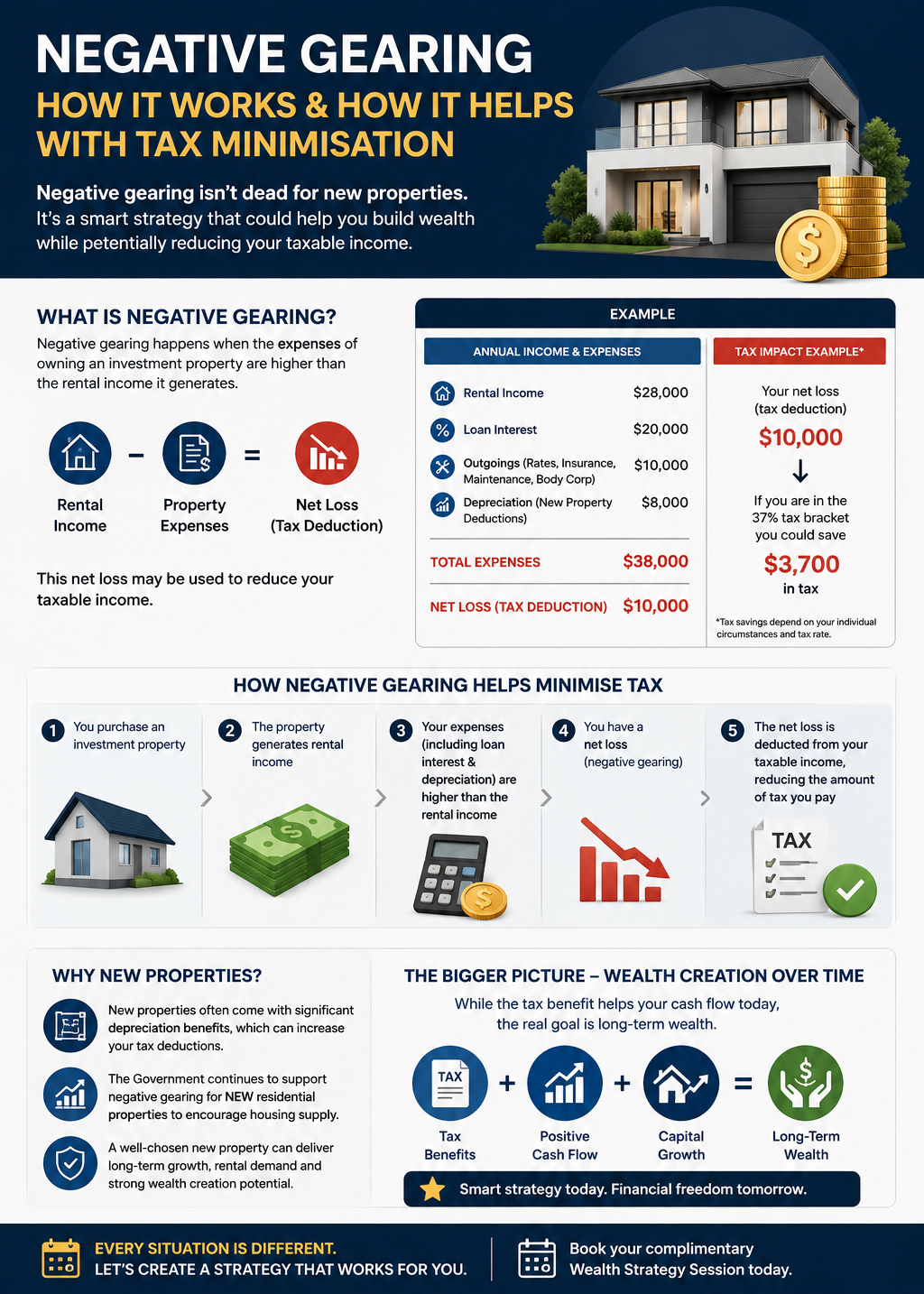
Depending on their tax bracket, that loss may reduce their overall tax liability.
However, it's important to understand that negative gearing does not create wealth by itself. A tax deduction simply reduces the cost of holding an investment. The real objective is to acquire an asset that has the potential to grow in value over time.
What Has Changed?
The Federal Government's 2026 tax reforms will limit traditional negative gearing benefits on many established residential properties purchased after 12 May 2026.
However, investors purchasing eligible new-build residential properties will continue to have access to negative gearing arrangements under the new framework. Existing investment properties held before the reforms are generally grandfathered under the previous rules.
In simple terms:
Existing Investment Properties Purchased Before the Changes
Existing rules generally continue to apply.
Investors maintain access to current negative gearing arrangements.
New-Build Investment Properties
Continue to receive favourable treatment.
Negative gearing remains available.
Government policy is designed to encourage investment into new housing supply.
Established Properties Purchased After the Reforms
Losses may no longer be immediately offset against wage income.
Different rules will apply regarding how losses are carried forward and utilised.
The key takeaway is simple:
Negative gearing is not dead for new properties.
Why Tax Should Never Be the Main Reason to Invest
One of the biggest mistakes investors make is chasing tax deductions.
A tax deduction means you are spending money to save a portion of that money in tax.
For example:
Would you spend $10,000 simply to receive a $3,000 tax refund?
Probably not.
Successful investors focus on:
✅ Long-term capital growth
✅ Strong location fundamentals
✅ Rental demand
✅ Cash flow sustainability
✅ Asset quality
The tax benefits should be viewed as an additional advantage—not the primary objective.
At PWF, we believe property investment should form part of a comprehensive wealth creation strategy rather than a short-term tax exercise.
The Hidden Benefit of New Properties: Depreciation
One of the reasons many investors consider new properties is depreciation.
New residential properties may provide significant depreciation allowances that can help reduce taxable income while not requiring additional cash outlay during the year.
Depreciation allows eligible investors to claim deductions relating to the wear and tear of certain building components and assets over time. The actual deductions available depend on the property, ownership structure and individual circumstances.
For many investors, depreciation can improve after-tax cash flow and make holding a property more manageable.
Professional tax advice should always be sought before making investment decisions.
Property Is About Wealth Creation, Not Tax Reduction
The most successful investors understand a fundamental principle:
The tax benefit is temporary. The wealth benefit is long-term.
Consider two investors:
Investor A
Focuses purely on reducing tax.
Purchases a property solely because it produces a large tax loss.
Ignores location and growth potential.
Investor B
Focuses on long-term wealth creation.
Purchases a quality property in a high-demand area.
Benefits from both capital growth and tax efficiencies.
Ten years later, Investor B is typically in a much stronger financial position.
The real question isn't:
"How much tax can I save?"
The better question is:
"How can I build long-term wealth while managing tax effectively?"
A Strategic Approach to Property Investing
At PWF, we help Australians focus on the bigger picture.
Rather than selecting property based solely on tax outcomes, we help clients develop a strategy that considers:
Income
Could the investment improve your overall financial position and borrowing capacity?
Growth
Is the property located in an area with strong long-term growth drivers?
Duplication
Can the strategy be repeated over time to help build a portfolio and accelerate wealth creation?
This approach aligns with our philosophy that successful property investing is about creating options, flexibility and financial freedom.
Is Negative Gearing Right for You?
Negative gearing can be an effective strategy for some investors, but it isn't suitable for everyone.
Factors to consider include:
Your income level
Cash flow position
Borrowing capacity
Risk tolerance
Investment timeframe
Overall financial goals
Every investor's situation is unique.
The best strategy is one that supports your long-term objectives while remaining financially sustainable.
Final Thoughts
Despite recent changes to Australia's property tax landscape, negative gearing remains available for eligible new-build residential properties. The Government's reforms are designed to direct investment toward new housing supply rather than established homes.
For investors willing to take a strategic approach, property can still offer:
Long-term wealth creation opportunities
Rental income
Potential capital growth
Tax efficiencies
Portfolio diversification
The key is not chasing tax deductions.
The key is building a strategy that aligns with your financial future.
Ready to Explore Your Options?
For more than 22 years, PWF has helped Australians create tailored property wealth strategies designed around their individual goals.
If you're wondering whether property investment could help you build wealth while managing tax effectively, book a complimentary Wealth Strategy Session with the PWF team.
There is no obligation, no pressure, and no one-size-fits-all solution.
Just practical guidance to help you understand what opportunities may be available to you.
Book your complimentary Wealth Strategy Session today and discover what a smarter property strategy could look like for your future.