
The Retirement Reality Check: Will Your Super Really Be Enough?
The Retirement Income Myth Many Australians Need to Rethink
For many Australians, superannuation is seen as the answer to retirement.
You work, your employer contributes to your super, your balance grows over time, and eventually you retire with a substantial amount of money sitting in your account.
But there is one question that many people don't ask early enough:
Will your super actually provide enough income to support the lifestyle you want in retirement?
The answer may be very different from what you expect.
If you are around 60 and have a super balance of approximately $450,000, that might sound like a significant amount of money.
But what happens when you stop working and need that money to fund your lifestyle for potentially 20, 25 or even 30 years?
The challenge is not simply accumulating a large super balance.
The real challenge is creating enough reliable income to support your lifestyle for the rest of your life.
The retirement numbers can be confronting
Consider a simple example.
An Australian earning around $100,000 a year is accustomed to receiving a substantial income while working.
If they retire and want to maintain a similar standard of living, their retirement savings need to generate an ongoing income.
Now consider someone aged around 60 with approximately $450,000 in super.
At first glance, $450,000 sounds like a lot.
But if you divide $450,000 by $100,000, you get just 4.5 years of income at that level.
Of course, retirement doesn't work as simply as withdrawing $100,000 every year. Your super can continue to earn investment returns, your spending may change, and you may receive other sources of income.
But the calculation highlights an important point:
A lump sum can look large until you convert it into the income you actually need.
And that is where many retirement plans can fall short.
Retirement could last longer than you think
One of the biggest mistakes people make is thinking about retirement as a short period.
You might retire at 65.
But that doesn't mean your financial planning only needs to cover the next five or ten years.
You could potentially spend 20 years or more in retirement.
That means the money you have accumulated needs to work for you for a very long time.
You need to consider:
How much income will you need each year?
How much will your lifestyle cost?
What happens when inflation increases your expenses?
What happens if investment returns are lower than expected?
How will you pay for travel, hobbies and other lifestyle expenses?
What happens if you need significant healthcare or aged-care support?
Will you want to help your children or grandchildren financially?
How much capital do you want to leave behind?
These questions can completely change how much you actually need to have accumulated before retirement.
The myth: "My super will take care of me"
Superannuation is an incredibly important part of Australia's retirement system.
But there is a difference between having super and having a retirement strategy.
Your super balance is an asset.
Your retirement lifestyle requires income.
Those two things are connected, but they are not the same thing.
Someone with $500,000 in super and someone with $500,000 in super plus an investment property generating rental income are in very different financial positions.
The same applies to someone who owns their home outright compared with someone entering retirement with a significant mortgage.
This is why retirement planning needs to look at the whole financial picture, rather than simply asking, "How much super do I have?"
Your income doesn't automatically stop being important when you retire
One of the biggest changes that happens when you retire is that your salary stops.
For decades, your employment income has helped pay for your mortgage, groceries, holidays, insurance, bills and lifestyle.
Suddenly, that income needs to be replaced.
This is why we believe Australians should think about retirement in terms of income-producing assets, not just accumulated savings.
The question becomes:
How can I create multiple sources of income before I retire?
That could include superannuation.
It could include investment income.
It could include rental income from property.
It could include other investments or business interests.
The goal is not necessarily to replace your working income dollar-for-dollar.
The goal is to build a financial structure capable of supporting the lifestyle you want without relying entirely on your employment income.

Why property can form part of a long-term wealth strategy
At PWF, we believe property can play an important role in a long-term wealth creation strategy when it is selected and structured appropriately.
The objective isn't simply to "buy a property".
It's about building a strategy around your current financial position, borrowing capacity, income, equity, investment goals and timeframe.
A well-structured property strategy can potentially provide two important benefits.
1. Growth
Quality property in the right locations can provide long-term capital growth.
Over many years, this can help build equity and increase your overall net wealth.
2. Income
Once debt is reduced or the property becomes unencumbered, rental income can potentially become an additional source of retirement income.
This is where the difference between building wealth and creating retirement income becomes important.
You may spend your working years accumulating assets.
But eventually, those assets need to help fund your lifestyle.
Don't wait until retirement to discover the numbers don't work
One of the biggest problems with retirement planning is that people often leave it too late.
At 60 or 65, you have fewer options than you had at 35, 40 or 45.
You have less time to:
Build assets
Grow equity
Reduce debt
Increase your investment income
Take advantage of your borrowing capacity
Recover from poor investment decisions
Adjust your strategy
Time is one of the most powerful advantages an investor has.
The earlier you understand the gap between where you are today and where you want to be, the more options you have to do something about it.
The important question isn't "How much do I have?"
It is:
"How much will I need?"
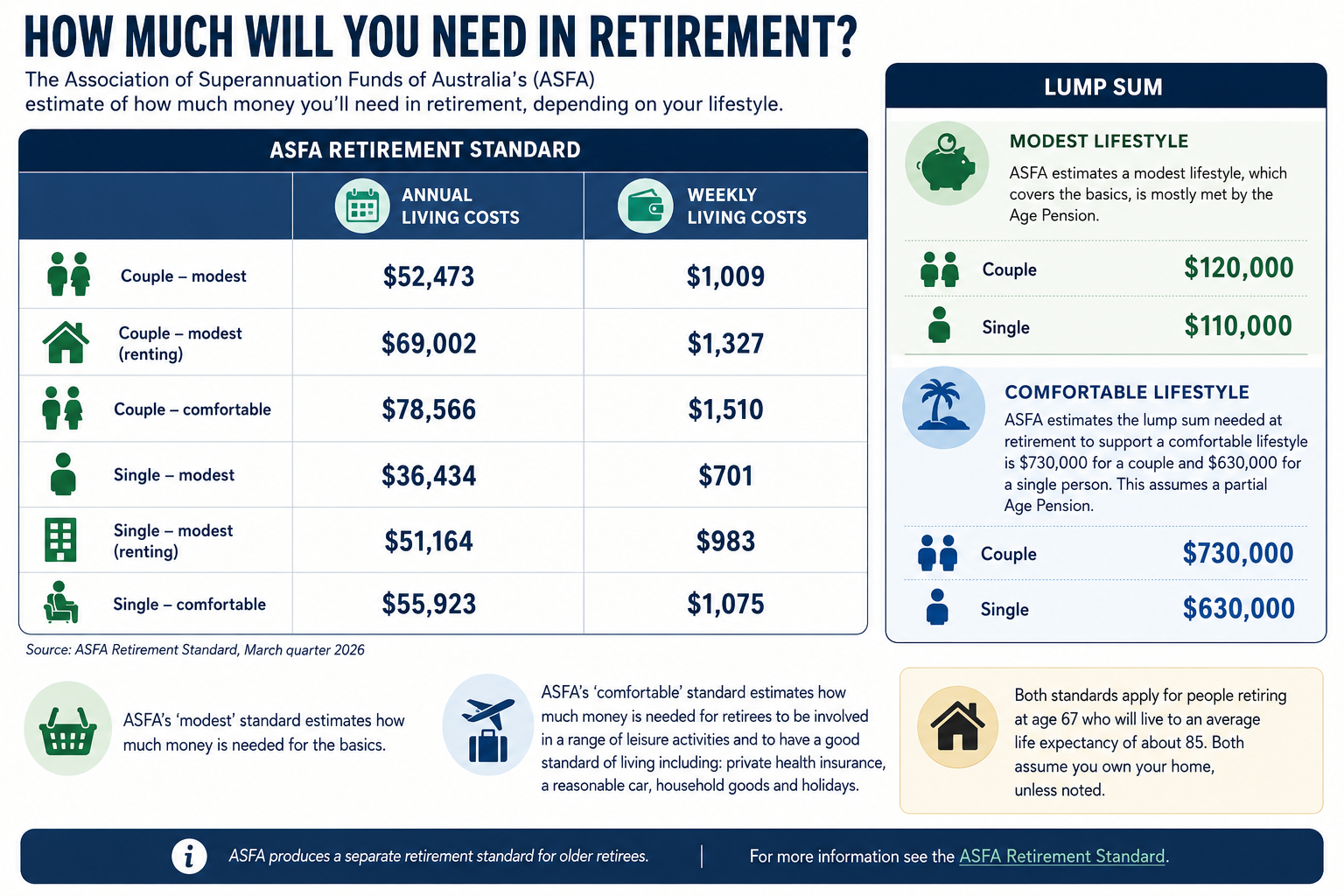
Retirement is one of the biggest financial milestones you'll face, but many Australians are unsure how much money they'll actually need. The latest ASFA Retirement Standard provides a useful guide to the annual income and superannuation savings required for both modest and comfortable retirement lifestyles, helping you understand whether your current retirement strategy is likely to support the future you want.
According to Australian Government’s website Moneysmart.gov.au, the lump sum needed at retirement to support a comfortable life style is $730,000 for a couple and $630,000 for a single person.
Start with How do you want to live?
Then work backwards.
How much income will that lifestyle require?
Then identify the gap.
What income will your existing assets provide?
Finally, build the strategy.
What needs to happen between now and retirement to close that gap?
That's a very different approach to simply checking your super balance once a year.
What happens if you retire with a shortfall?
Suppose you reach retirement and discover that your super and other assets aren't going to provide the income you expected.
You have several choices.
You could reduce your lifestyle.
You could work longer.
You could draw down your capital more quickly.
You could sell assets.
Or you could rely more heavily on government benefits, depending on your circumstances and eligibility.
None of these options are necessarily ideal if they weren't part of your original plan.
The better approach is to identify the potential shortfall before you reach retirement.

want to be financially.
Your retirement strategy shouldn't start at retirement
The biggest misconception is that retirement planning is something you do when you are approaching retirement.
In reality, the best time to identify your retirement income gap is years before you need the money.
The earlier you start, the more tools you potentially have available.
You have more time.
More borrowing capacity.
More opportunity to build equity.
More opportunity for assets to grow.
And, importantly, more time to make adjustments if your strategy isn't working.
Ask yourself these five questions
If retirement is important to you, take some time to answer these questions:
1. How much income will I actually need in retirement?
Don't guess. Think about your desired lifestyle.
2. Where will that income come from?
Super? Investments? Property? Other assets? Government benefits?
3. How long does my money need to last?
Don't plan for five years if you could spend 20 or 30 years in retirement.
4. What is my current retirement income gap?
Understand the difference between the income your assets are likely to generate and the income you want.
5. What can I do today to reduce that gap?
This is where strategy becomes important.
Don't leave your retirement to chance
Having superannuation is important.
But having super doesn't automatically mean you have a retirement plan.
A $450,000 super balance might sound substantial today. But when you consider how long retirement could last, how much income you may require and the impact of inflation and investment performance, the number can look very different.
Retirement isn't about how big your balance looks. It's about whether your assets can provide the income you need for the life you want.
The good news is that you don't have to wait until retirement to find out whether your numbers work.
Start with where you are today.
Understand the gap.
Build a strategy.
Then keep reviewing it as your circumstances change.
Wealth creation should have a purpose
At PWF, we don't believe wealth creation should simply be about watching a number increase on a statement.
There should be a reason behind it.
For many Australians, that reason is financial freedom.
It could mean having the choice to retire when you want.
It could mean travelling more.
It could mean helping your children.
It could mean reducing financial stress.
Or simply knowing that you don't have to depend entirely on a salary for the rest of your life.
Your wealth strategy should ultimately serve the life you want to live.
The PWF approach: Income, Growth and Duplicate
At PWF, our Wise Wealth Plan is built around three key pillars:
1. Income
We look at ways to improve your income and borrowing capacity through appropriate strategies and property solutions.
For example, certain property structures, such as dual-occupancy properties, may provide opportunities to increase rental income while supporting your broader investment strategy.
2. Growth
We focus on building wealth through quality assets in locations with strong long-term growth potential.
The objective is not to chase the latest property hotspot.
It's about identifying assets that can contribute to a long-term wealth strategy.
3. Duplication
Once the strategy is working, we look at how it can be repeated.
Build income.
Build growth.
Build equity.
Then assess whether you can do it again.
Over time, this can create a portfolio designed to progressively close the gap between where you are today and where you
Ready to understand your retirement wealth gap?
At PWF, we help Australians develop long-term wealth strategies designed around their individual circumstances and goals.
If you're unsure whether your current super, property and investments will provide the retirement income you want, the first step is to understand the numbers.
Don't wait until retirement to discover the gap.
Speak with the PWF team and start building a strategy for the financial future you want.
PWF — We win when you do.