
Regional Australia Is No Longer a Second Choice: The Migration Trend Reshaping Property Markets
Record Numbers of Australians Are Choosing Regional Living
A major shift is reshaping Australia's property market.
For years, Australia's capital cities have dominated property discussions, attracting buyers, investors and migrants chasing employment opportunities and lifestyle benefits. However, the latest migration data suggests the tide is turning.
According to the latest Regional Movers Index, Australians are leaving capital cities in record numbers and choosing regional locations that offer greater affordability, lifestyle advantages and long-term growth potential.
It's a trend we've been watching closely for years, and the latest figures confirm what many strategic investors are already recognising: regional Australia is no longer a second choice.
The Great Regional Migration Continues: Buyers depart Brisbane, Perth, Adelaide
Between January and March 2026, the number of Australians moving from capital cities to regional areas was 29.7% higher than those making the move in the opposite direction.
Regional moves accounted for 11.9% of all internal migration during the quarter, representing a 20.1% increase compared to the previous quarter and a 4.7% increase year-on-year.
What began as a trend during the pandemic has evolved into a long-term demographic shift that continues to gain momentum.
As more Australians reassess where they want to live and invest, regional centres are increasingly becoming the preferred destination.
Affordability Is Driving Decision Making
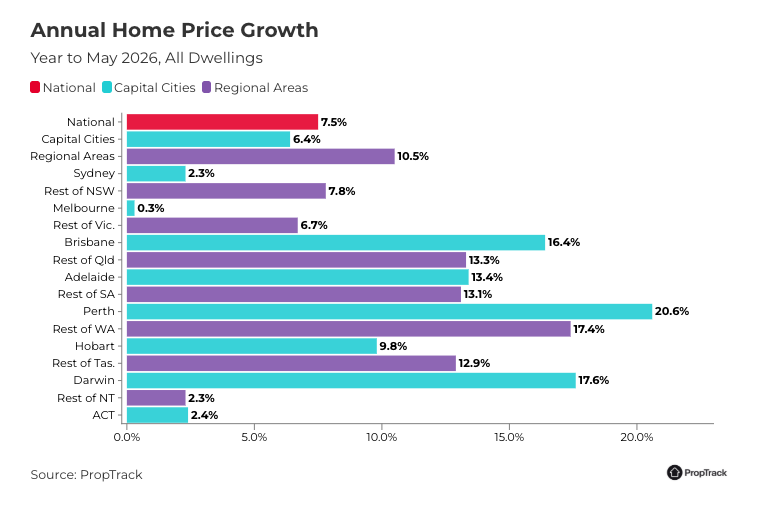
Annual Home Price Growth
One of the biggest factors behind this migration trend is the widening affordability gap between capital cities and regional Australia.
The median price of a home across Australia's capital cities has now reached:
$1,012,000
That's an increase of 6.4% over the past 12 months and almost $65,000 higher than this time last year.
By comparison, the median home price across regional Australia sits at:
$723,000
For many families and investors, that difference represents a significant opportunity to secure more land, larger homes, stronger cash flow and a better overall lifestyle.
As affordability pressures continue to rise, more Australians are broadening their search beyond traditional metropolitan markets.
Australia's Affordable Capitals Are Now Feeling the Pressure
Historically, Sydney and Melbourne have been the primary contributors to capital-city outflows. However, 2026 has revealed a broader national trend.
Brisbane, Perth and Adelaide are now increasingly contributing to migration towards regional Australia as affordability challenges spread across the country.
The latest data shows migration is becoming more geographically diverse, with residents from multiple states choosing regional alternatives rather than remaining concentrated in New South Wales and Victoria.
Brisbane recorded a 1% increase in residents relocating to regional areas during the first quarter of the year, while regional Queensland experienced a 20% surge in new arrivals.
This shift is not surprising when considering Brisbane's property market. Home prices have increased 16.4% over the past year, pushing the median home price to approximately $1.08 million. In comparison, the average home across regional Queensland sits around $836,000.
Western Australia has experienced a similar trend, with migration to regional areas increasing from 5% to 8% compared to the same period last year.
South Australia also recorded stronger regional migration, with the proportion of residents moving to regional locations increasing from 5% to 6%.
Even Canberra recorded net outflows for the first time on record, highlighting how widespread this migration trend has become.
Geelong Continues to Lead the Way

Photo Credit: VisitMELEBOURNE.COM
The latest report also reinforces the strength of one of Australia's standout regional markets.
Alongside the Sunshine Coast, Geelong remains one of the most popular destinations for Australians leaving the capital cities.
Together, Geelong and the Sunshine Coast account for 12.7% of all capital-to-regional migration and 14% of total net migration nationally.
This is particularly significant because Geelong's appeal extends far beyond affordability.
The region continues to benefit from:
Strong population growth
Significant infrastructure investment
Expanding employment opportunities
Proximity to Melbourne
Lifestyle appeal for families and professionals
Ongoing urban development
These are some of the reasons we have continued to advocate for the Geelong market and assist clients in securing opportunities within the region.
The underlying fundamentals remain compelling and the migration data continues to support the long-term outlook.
Emerging Regional Hotspots to Watch
While Geelong and the Sunshine Coast remain the leaders by migration volume, several other regional centres are experiencing extraordinary growth.
Some of the fastest-growing destinations for incoming city residents include:
Toowoomba (+236.4%)
Broome (+168.8%)
Townsville (+159.7%)
Clarence Valley, NSW (+444.1%)
Indigo, Victoria (+133.3%)
These locations are benefiting from the same factors driving migration nationally: affordability, lifestyle, employment opportunities and improving infrastructure.
As population growth accelerates, these markets may continue to attract increasing investor attention.
Why Population Growth Matters for Investors
One of the most reliable drivers of property demand is population growth.
When more people move into an area, demand for housing naturally increases. Over time, this can place upward pressure on rents, occupancy rates and property values.
The latest migration figures suggest many regional markets are entering a new phase of growth supported by strong demographic trends.
For investors, understanding where people are moving—and why—can be just as important as analysing property prices alone.
Markets that combine affordability, infrastructure investment, employment growth and population inflows often create the foundations for long-term performance.
The Bottom Line
Australia's property landscape is changing.
Regional Australia is no longer viewed as a fallback option for buyers priced out of the capital cities. Increasingly, it is becoming the preferred choice for Australians seeking affordability, lifestyle and future opportunity.
The latest migration data confirms that this trend is not slowing down.
From Geelong and the Sunshine Coast to emerging hotspots across Queensland, Victoria and beyond, regional markets continue to attract growing numbers of Australians looking to build a better future.
For investors, the question is no longer whether regional Australia deserves consideration.
The question is whether your investment strategy is positioned to benefit from one of the most significant demographic shifts shaping Australia's property market today.
The Opportunity Is Clear. The Question Is: Will You Act?
The migration trend reshaping Australia isn't a prediction—it's happening right now.
Thousands of Australians are moving to regions that offer greater affordability, stronger lifestyle benefits and long-term growth potential. As population follows opportunity, property markets in the right locations stand to benefit for years to come.
The investors who build lasting wealth are rarely the ones who wait until everyone else has arrived. They're the ones who recognise the trend early, create a plan and take action.
At PWF, we've been helping Australians build wealth for more than 22 years. Our clients don't rely on luck, market timing or speculation. They succeed because they have a strategy backed by research, experience and a team committed to helping them achieve their long-term goals.
The opportunities are there. The data is clear. The trends are already underway.
The only question that remains is:
Do you have a plan to take advantage of them?
If you're ready to explore how property could help you build long-term wealth, book a complimentary strategy session with one of PWF's Senior Strategists today. Together, we'll help you create a personalised roadmap designed to grow, protect and accelerate your wealth for the years ahead.
Because your future wealth won't be determined by what happens in the market. It will be determined by the decisions you make today.