
What Does $1 Million Buy in Australia's Property Market?
For years, a $1 million property budget was considered the benchmark for a premium home. Today, that reality has changed dramatically.
Across Australia, population growth, chronic housing shortages and changing affordability have transformed what $1 million can actually buy. In many markets, it is no longer considered a luxury budget—it has become the new entry point for a standard family home.
The latest Herron Todd White Month in Review highlights just how dramatically purchasing power has shifted across the country. While some markets continue to outperform, others are presenting new opportunities for buyers and investors who understand where value still exists.
For Australians looking to build long-term wealth through property, understanding these market dynamics has never been more important.
Australia's Property Market
Australia's residential property market continues to balance several competing forces.
On one hand, higher interest rates, persistent inflation and uncertainty surrounding proposed tax reforms have moderated buyer confidence. On the other, Australia's housing shortage continues to underpin prices and rental demand.
Current market conditions include:
The Reserve Bank has maintained the cash rate at 4.35%.
National dwelling values recently recorded their first month without growth since early 2025.
Capital cities have softened slightly, while regional markets continue to outperform.
Lower-priced properties remain resilient as first-home buyers and investors compete for affordable stock.
Premium properties continue to soften due to reduced borrowing capacity.
Rental markets remain exceptionally tight, with strong annual rental growth and national vacancy rates sitting at just 1.5%.
Despite economic headwinds, Australia's structural housing undersupply continues to provide strong long-term support for residential property values.
The New Reality: Why $1 Million Isn't What It Used to Be
Years of population growth, limited housing supply and rising construction costs have fundamentally reshaped affordability. Buyers have adjusted their expectations, while investors have become increasingly strategic about where they deploy their capital.
Here's what $1 million buys across Australia today.
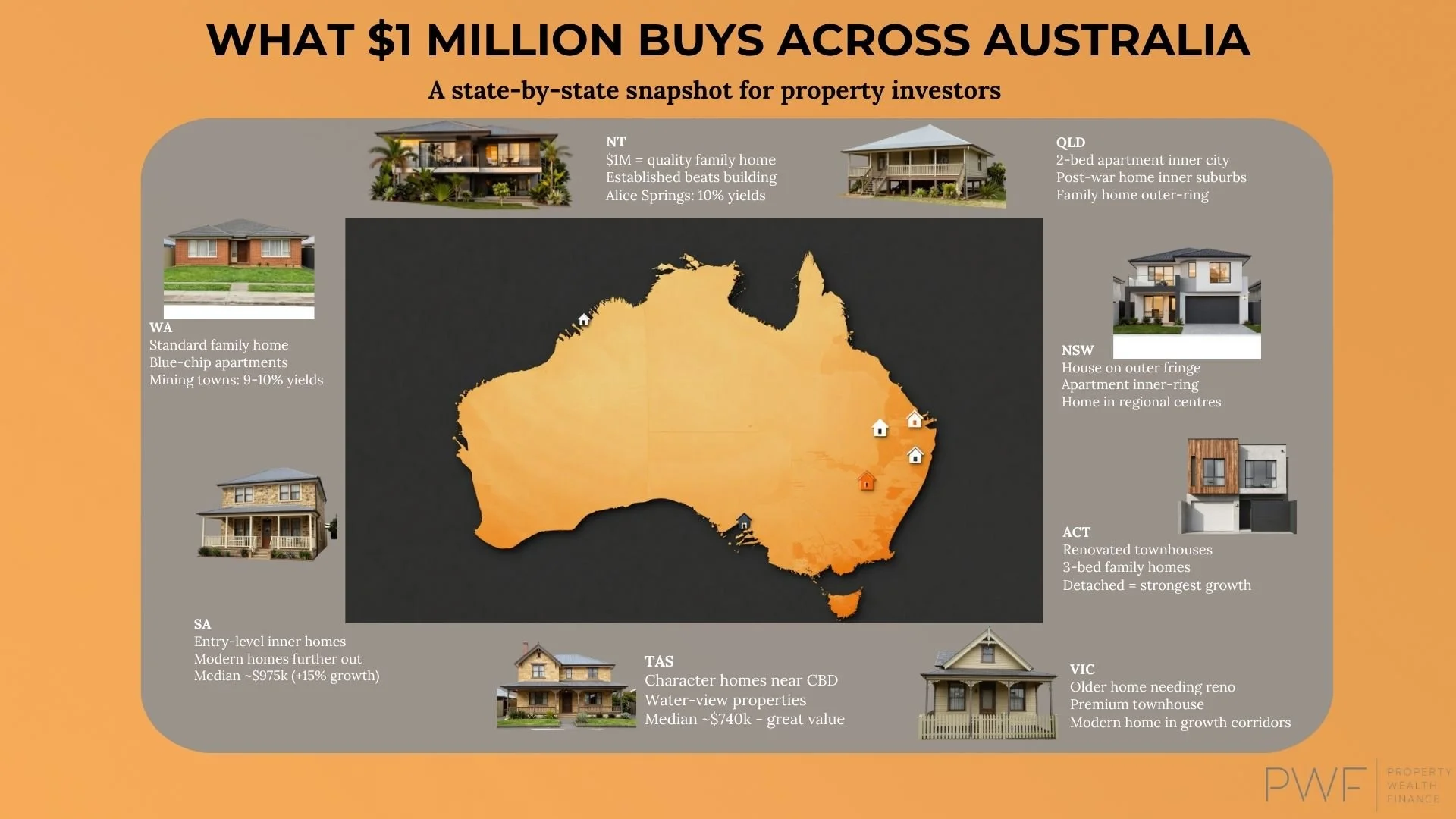
New South Wales
Sydney
Sydney has become a true two-speed market.
Affordable suburbs continue to perform strongly, supported by first-home buyers and government initiatives such as the 5% deposit scheme.
Meanwhile, premium suburbs have experienced softer pricing as borrowing capacity remains constrained.
Today, a $1 million budget generally secures:
A house on Sydney's outer fringe
An apartment in an inner-ring suburb
A home in secondary metropolitan locations
The era of buying established family homes close to the CBD for under $1 million is largely over.
Regional NSW
Sydney's affordability challenges continue to drive demand into regional centres.
The Illawarra has benefited significantly from metropolitan migration, with $1 million remaining highly competitive for quality family homes and premium northern suburbs.
In Newcastle, suburbs once considered affordable have now crossed the million-dollar threshold, highlighting the continued strength of regional NSW.
Victoria
Melbourne
Melbourne continues to offer more purchasing flexibility than Sydney, although competition remains intense below $950,000.
A $1 million budget can generally secure:
An older detached home requiring renovation
A premium townhouse in established suburbs
Modern homes in middle-to-outer growth corridors
Interestingly, several suburbs that previously exceeded the million-dollar mark have softened, creating renewed opportunities for buyers.
Investors are also increasingly purchasing two smaller investment properties instead of one larger home, helping diversify rental income.
Regional Victoria
Following the extraordinary growth experienced during the pandemic, Geelong has undergone a market correction.
Property values have eased around 11%, allowing premium suburbs such as Manifold Heights to re-enter the $1 million buying range.
For long-term investors, this may represent an attractive opportunity as the market stabilises.
Queensland
Brisbane
Brisbane has officially become Australia's second most expensive capital city, with median house values reaching approximately $1.1 million.
A $1 million budget now typically purchases:
A quality two-bedroom apartment in the inner city
A basic post-war home in established inner suburbs
A modern family home in middle and outer-ring locations
Although demand has moderated slightly, Brisbane continues to benefit from strong interstate migration and limited housing supply.
Gold Coast
The Gold Coast continues to experience exceptional demand.
Properties below the million-dollar mark have recorded price growth between 5% and 15% over the past six to nine months.
However, buyers at this price point should expect apartments and attached dwellings rather than detached family homes.
Sunshine Coast
Affordability has become increasingly challenging.
An extraordinary 90 of the region's 95 suburbs now have median house prices exceeding $1 million, reinforcing the Sunshine Coast's evolution into one of Australia's premium lifestyle markets.
Western Australia
Perth
Perth continues to experience one of Australia's strongest-performing markets.
Today, $1 million represents:
A standard metropolitan family home
Entry into blue-chip apartment markets
Significantly less purchasing power than just a few years ago
Strong population growth and ongoing housing shortages continue to place upward pressure on prices across the metropolitan area.
Regional WA
For investors focused on cash flow, regional Western Australia remains particularly compelling.
Mining centres such as Karratha and Port Hedland continue delivering gross rental yields between 9% and 10%, with quality four-bedroom homes trading around the $1 million mark.
South Australia
Adelaide
Adelaide's remarkable growth story continues.
Median dwelling values have reached approximately $975,000, representing annual growth of around 15%.
Today, $1 million generally secures:
Entry-level family homes in established inner suburbs
High-quality modern homes further from the CBD
Smaller dwellings in premium inner-city locations
Just a few years ago, these properties would have been substantially more affordable.
Northern Territory
Darwin
Construction costs continue to reshape Darwin's housing market.
Buying an established home is now significantly more cost-effective than building new, making existing detached homes increasingly attractive.
A $1 million budget has effectively become the benchmark for quality family homes.
Alice Springs
While capital growth has stabilised, investors continue to enjoy exceptional rental returns.
Older units priced between $220,000 and $350,000 can deliver rental yields approaching 10%, supported by extremely tight vacancy rates.
Australian Capital Territory
Canberra
Canberra remains a balanced market.
A $1 million budget generally provides:
Renovated townhouses in desirable inner suburbs
Three-bedroom family homes in established middle-ring locations
Detached housing continues to offer the strongest long-term growth prospects due to constrained land supply and consistent family demand.
Tasmania
Hobart
Hobart remains one of Australia's more accessible capital cities.
With median house prices around $740,000, buyers still have considerable purchasing power.
A $1 million budget can secure:
Character homes close to the CBD
Water-view properties
Established family homes in highly desirable suburbs
Compared with mainland capitals, Hobart continues to offer excellent value.
The Bottom Line
The Australian property market has entered a new era.
A $1 million budget no longer guarantees a premium property—in many parts of Australia, it simply secures an average family home.
Yet despite changing affordability, opportunities remain for buyers and investors who understand where value exists.
Regional markets continue to outperform many capital cities. Rental demand remains exceptionally strong. Population growth and housing shortages continue to support long-term market fundamentals.
Success in today's market isn't simply about having a larger budget—it's about having the right strategy.
Ready to Build Wealth Through Property?
At Property Wealth Finance (PWF), we've spent more than 22 years helping Australians make smarter property investment decisions.
Whether you're purchasing your first investment property, leveraging equity in your home, or looking to build a diversified portfolio, our experienced property strategists help you identify opportunities that align with your long-term financial goals.
The market has changed—but with the right advice and a tailored investment strategy, there are still outstanding opportunities to grow wealth through property.
Book a complimentary strategy session with PWF today and discover how your current financial position could help you take the next step towards long-term wealth creation.